Ancient Tooth Tartar Traps Clues to Iron Age Diet

By analyzing the proteins in ancient dental plaque, archaeologists determined that British menus almost three millennia ago featured milk, oats and peas. Christopher Intagliata reports.

Illustration of a Bohr atom model spinning around the words Science Quickly with various science and medicine related icons around the text

Join Our Community of Science Lovers!

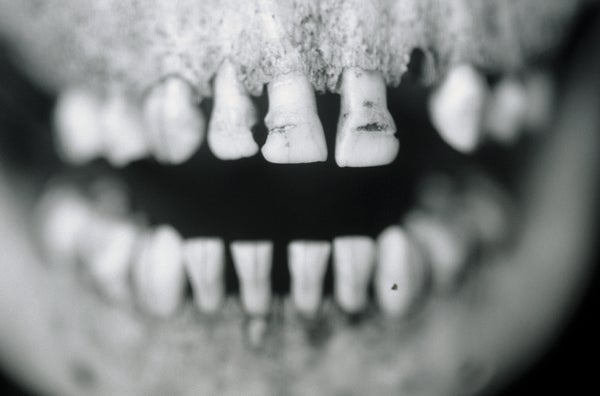
We have pretty good dental hygiene today—regular brushing, flossing, dental visits. But thousands of years ago? Not so much. Which means the old-timers' teeth had a lot of plaque. And today that ancient tartar is a gold mine for archaeologists.

"What that's doing is entombing all this biomolecular information that comes from your mouth." Jessica Hendy, an archaeological scientist with the Max Planck Institute in Germany. 

Hendy and her team used dental scrapers—just like your dentist uses—to remove tartar from human teeth found in Great Britain, dating from the the eighth century B.C.…the Iron Age…all the way to the 1800s. With some modern samples thrown in, as a metric. They extracted proteins from the dental scrapings, then used mass spectrometry to reconstruct the menu.


On supporting science journalism

If you're enjoying this article, consider supporting our award-winning journalism by subscribing. By purchasing a subscription you are helping to ensure the future of impactful stories about the discoveries and ideas shaping our world today.


Across the ages were the remains of dairy products. "As well as milk we found evidence of cereal, specifically oats, and evidence of peas, and something in the cabbage family." The full bill of fare is in the Proceedings of the Royal Society B. [Hendy J et al., Proteomic evidence of dietary sources in ancient dental calculus]

The study shows that probing proteins in tartar can help figure out ancient diets—especially for foods that themselves don't preserve well. And though good oral hygiene is extremely important…, if you forget to floss tonight, future archaeologists may thank you. 

—Christopher Intagliata

[The above text is a transcript of this podcast.]

It’s Time to Stand Up for Science

If you enjoyed this article, I’d like to ask for your support. Scientific American has served as an advocate for science and industry for 180 years, and right now may be the most critical moment in that two-century history.

I’ve been a Scientific American subscriber since I was 12 years old, and it helped shape the way I look at the world. SciAm always educates and delights me, and inspires a sense of awe for our vast, beautiful universe. I hope it does that for you, too.

If you subscribe to Scientific American, you help ensure that our coverage is centered on meaningful research and discovery; that we have the resources to report on the decisions that threaten labs across the U.S.; and that we support both budding and working scientists at a time when the value of science itself too often goes unrecognized.

In return, you get essential news, captivating podcasts, brilliant infographics, can't-miss newsletters, must-watch videos, challenging games, and the science world's best writing and reporting. You can even gift someone a subscription.

There has never been a more important time for us to stand up and show why science matters. I hope you’ll support us in that mission.

Thank you,

David M. Ewalt, Editor in Chief, Scientific American

Subscribe