
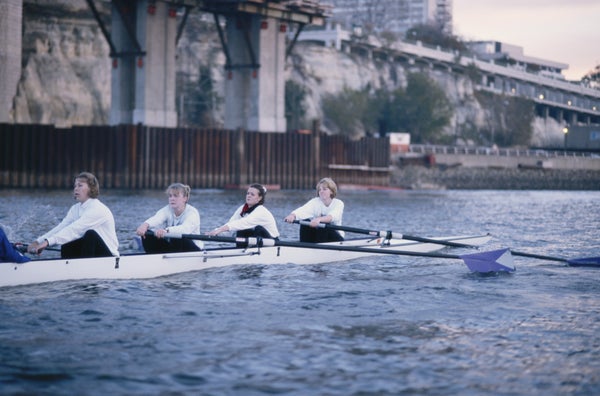

Picture a women’s crew team. Training 18 hours and covering 75 miles in an average week, these athletes are pretty ripped. Yet they don’t hold a bicep to prehistoric female farmers. Because a new study shows that, based on upper arm strength, the Neolithic ladies leave modern women—even elite athletes—in the dust. The work appears in the journal Science Advances. [Alison A. Macintosh, Ron Pinhasi and Jay T. Stock, Prehistoric women’s manual labor exceeded that of athletes through the first 5,500 years of farming in Central Europe]
The study’s researchers had previously examined the bones of prehistoric men. Because bones adapt to the load they bear, they can provide a record of the sort of activities in which an individual regularly engages. So, at the dawn of agriculture, men’s leg bones were strong, like today’s cross-country runners. But by the late Iron Age, their leg bones looked more like that of the average couch potato.
“So this kind of matched with declines in mobility as people became more sedentary through time.”
On supporting science journalism
If you're enjoying this article, consider supporting our award-winning journalism by subscribing. By purchasing a subscription you are helping to ensure the future of impactful stories about the discoveries and ideas shaping our world today.
Alison Macintosh, who did that work when she was an undergraduate student in archaeology at the University of Cambridge.
“But we didn’t see these drops in women. Their leg bone strength was consistently lower than men’s, it didn’t change significantly through time. So really the women just looked quite sedentary pretty much right from the get-go. And we didn’t think that was very probably necessarily a very accurate representation of what they had been doing.”
Now, it could be that prehistoric housewives sat around and lunched their way through the Neolithic. But Macintosh thought that unlikely. Instead, she and her colleagues figured that the bones of men and women react differently under pressure. So Macintosh, now a postdoctoral fellow with the same group, decided to look at the limbs of some ladies.
She recruited 18 championship rowers, 11 soccer players, 17 runners and 37 somewhat less sporty undergrads. And she scanned their upper arms and lower legs. What she found is that the leg bone strength of prehistoric women was as variable as that of her living subjects, running the gamut from those who run marathons to those who engage in marathon study sessions. But the arms were a different story.
“We found that prehistoric women had stronger arm bones on average than most living women. That was pretty consistent through the first 5,500 years of farming or so. So this was even stronger than the arm bones of the rowers. So for example women in the earliest time period that we looked at, which is the early Neolithic period about 7,000 years ago, they had arm bones that were 30 percent stronger than nonathletes today, so just recreationally active women in Cambridge. And they’re about 16 percent stronger bones than those of the living rowers.”
That power most likely came from tilling the soil, harvesting crops, and spending hours a day milling grain to make flour with a stone-age mortar and pestle. The findings shed light on the daily duties of our female ancestors—manual labor that was a total grind.
—Karen Hopkin
[The above text is a transcript of this podcast.]
