

February was unusually hot in the Arctic. Thawing out temperature: 35 degrees Fahrenheit.
"It made big news when it got to 35, I don't know if that's T-shirt weather yet, but…"
Judah Cohen, a climatologist at Atmospheric and Environmental Research, a company that does consulting on weather and climate. "The Arctic relatively is a much warmer place than it used to be."
On supporting science journalism
If you're enjoying this article, consider supporting our award-winning journalism by subscribing. By purchasing a subscription you are helping to ensure the future of impactful stories about the discoveries and ideas shaping our world today.
Over the last few decades, the Arctic has heated up two to three times faster than the rest of the planet. But in the same period, Eurasia and the northeastern U.S. have been on a cold streak. With some serious cold air and snow.
<
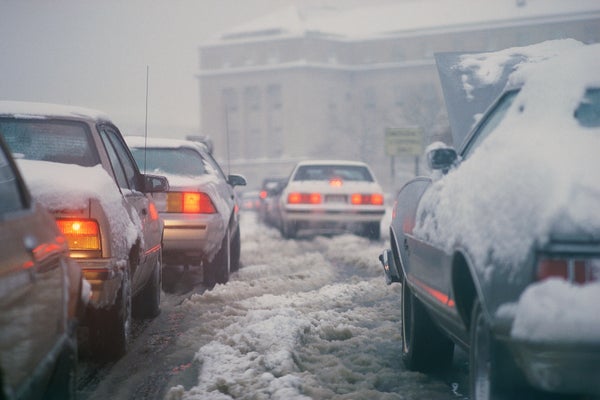
Climate-change-denying politicians like to point to the cold snaps as some sort of proof global warming is not happening. But a new analysis of more than six decades of daily temperature and snowfall data by Cohen and his team suggests arctic heat waves may actually be linked to severe cold weather at lower latitudes… perhaps through the polar vortex.
"A warmer Arctic in general kind of favors these polar vortex disruptions. And when you get a polar vortex disruption, warm air from the lower latitudes rushes in to the Arctic, and you can get extreme warm events like we saw in February. But then the cold air that's normally locked up over the Arctic gets displaced and it heads to lower latitudes. It's all connected, I think it's all part of the same phenomenon."
The details are in the journal Nature Communications. [Judah Cohen, Karl Pfeiffer & Jennifer A. Francis, Warm Arctic episodes linked with increased frequency of extreme winter weather in the United States]
Important caveat: this research is just an observational study. So it doesn't show a definite mechanism for a warm Arctic causing more snowpocalypses. But if further studies bear this connection out, perhaps it'll kill the idea that cold weather means no climate change… and help keep snowballs off the senate floor.
--Christopher Intagliata
[The above text is a transcript of this podcast.]
