
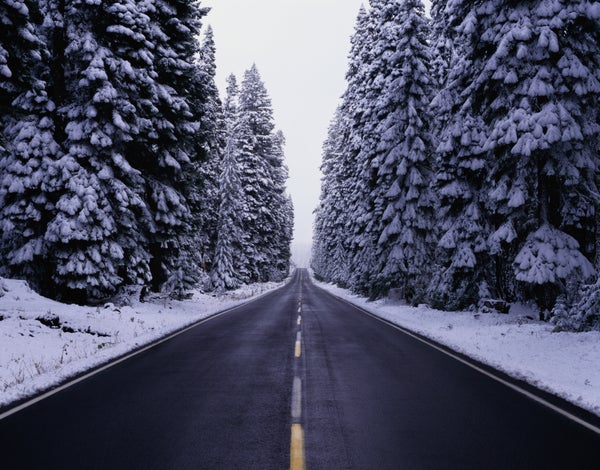

Every winter some 20 million tons of salt are dumped on America's roads. The sodium chloride melts ice or prevents its formation, helping to prevent accidents. But road salt has its downsides. "This is actually not very economical, because salt is mainly corrosive." Seda Kizilel, a chemical engineer at Koc University in Istanbul, Turkey. She says salt's corrosive effects don't discriminate—they affect "vehicles and also nature, plants, microorganisms."
So Kizilel and her colleagues designed a road substance that can de-ice itself. They started with a polymer called SBS, commonly added to strengthen asphalt. They whipped up an emulsion of SBS with potassium formate, an alternative salt that's been studied as a more environmentally friendly de-icer than regular road salt. Then they added that emulsion to bitumen--the sticky black stuff in asphalt.
On supporting science journalism
If you're enjoying this article, consider supporting our award-winning journalism by subscribing. By purchasing a subscription you are helping to ensure the future of impactful stories about the discoveries and ideas shaping our world today.
They subjected their creation and regular bitumen to the winter weather conditions that typically lead to black ice. Turns out the hybrid compound delayed ice formation 10 minutes longer than the control. And the samples continued releasing salt for more than two months. The study is in the journal Industrial & Engineering Chemistry Research. [Derya Aydin et al, Gelation-Stabilized Functional Composite-Modified Bitumen for Anti-icing Purposes]
Of course, 10 minutes of de-icing is a nice head start—but it's not going to put salt truck drivers out of business. "But we're saying that, during the first 10 to 15 minutes, when the road becomes very icy, this material and this release of salt from this functional bitumen is going to be very useful and potentially eliminate many accidents on the roads." The next step, she says, is to pave a test surface and drive on it--to literally see what happens when the rubber meets the road.
— Christopher Intagliata
[The above text is a transcript of this podcast.]
