
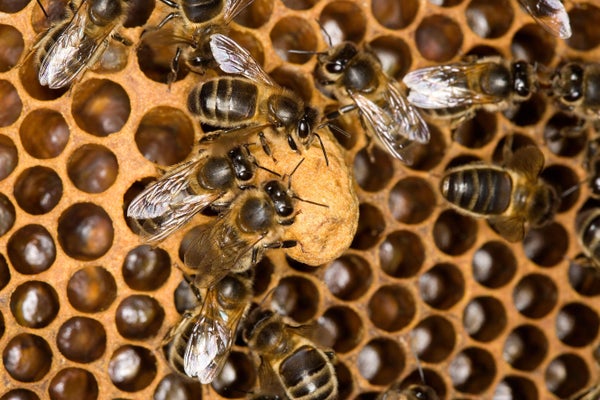

If there’s one thing we can all agree on, it’s that taking care of babies is a demanding business. New parents are always on duty, and late-night feedings and fussing leave caregivers chronically sleep-deprived. Turns out the issue is not unique to humans, because the same thing happens to bees. Researchers found that worker bees who care for the brood get less sleep than their sisters, because bee babies produce chemicals that keep their caretakers awake. The findings appear in the journal Current Biology. [Moshe Nagari et al., Bumble bee workers give up sleep to care for offspring that are not their own]
It seems that all animals sleep, including the birds and the bees. Yet this daily phenomenon still remains blanketed in mystery.
“The exact function of sleep is still an enigma, but we know that reduced or sleep loss is associated with reduced performance, health and survival.”
On supporting science journalism
If you're enjoying this article, consider supporting our award-winning journalism by subscribing. By purchasing a subscription you are helping to ensure the future of impactful stories about the discoveries and ideas shaping our world today.
Moshe Nagari was a postdoc at the Hebrew University of Jerusalem when he started studying sleep. In particular, he was curious about how animals can sometimes sacrifice shut-eye when they’ve got important work to do—especially moms tending to their young.
“Killer whale mothers, for example, follow their cubs for the first few weeks postpartum and hardly ever sleep in this time for several weeks.”
Rather than swimming along with killer whales for a couple of months, Nagari focused his attention on bumblebees. In these colonies, a queen lays the eggs, and worker bees called nurses care for the resulting hatchlings. To start, Nagari confirmed that when nurses were housed with larvae, they slept significantly less than bees who didn’t have babies to attend to.
“So our first intuition was that the larvae are constantly signaling to the nurse bees that they are hungry, and this signaling is what’s keeping the nurse bees awake.”
So the researchers replaced the larvae with pupae, a developmental stage that doesn’t require constant feeding.
“And to our surprise, we found that nurse bees with pupae slept even less than the bees that were housed with feeding larvae.”
These babies, it seemed, needed the bee equivalent of swaddling.
“Indeed, in our observations, we saw that the nurses were incubating the pupae at the expense of sleep.”
What’s more, the babies didn’t even have to be there. It seems that simply surrounding the nurses with the cocoons in which the pupae had been resting was enough to keep the caregivers awake and on their toes—which suggests that baby bees secrete a chemical that does the work of a late-night cup of coffee.
“If this interpretation is true, this is the first evidence that pheromones from juveniles can modulate the sleep of caregiver adults in any animal....”
Keeping adult bees from getting their z’s.
—Karen Hopkin
[The above text is a transcript of this podcast.]
