
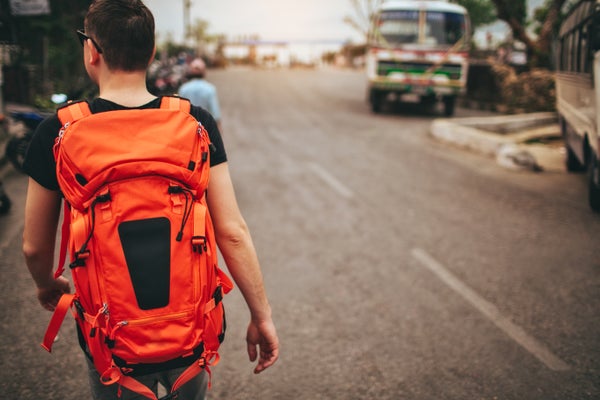

When you walk with a backpack, you know how the stuff inside sways from side to side? Now scientists have figured out how to tap into that motion to generate electricity.
Here's how it works. Picture a pendulum mounted to a backpack frame and stabilized with springs on either side. The pack's weight is attached to the pendulum, so the pendulum swings side to side as you walk. Gears then use that swinging motion to drive a generator, and the generator spits out electrical current to charge a battery.
Volunteers carried the pack while walking on a treadmill and wore masks to measure the flow of oxygen and carbon dioxide. Walking with the slightly swaying 20-pound load, the device did not significantly affect the volunteers' metabolic rate compared to when they carried the same weight fixed in place. In fact, the energy-harvesting pack reduced the forces of acceleration they'd feel in a regular pack, which might mean greater comfort for a long hike. And the device did produce a steady trickle of electricity—the operative word being trickle.
On supporting science journalism
If you're enjoying this article, consider supporting our award-winning journalism by subscribing. By purchasing a subscription you are helping to ensure the future of impactful stories about the discoveries and ideas shaping our world today.
Because if you up the load to 45 pounds, the passive motion of the pack could fully charge a Samsung Galaxy S10 smartphone only after 12 hours on the trail. The details are in the journal Royal Society Open Science. [Jean-Paul Martin and Qingguo Li, Generating electricity while walking with a medial–lateral oscillating load carriage device]
But here's the rucksack rub: the energy-harvesting device currently weighs five pounds. The researchers say that's about four pounds too many to be a smart alternative to batteries. So they hope that more research lets them lighten the load, to ensure the pack charges you up without weighing you down.
—Christopher Intagliata
[The above text is a transcript of this podcast.]

