
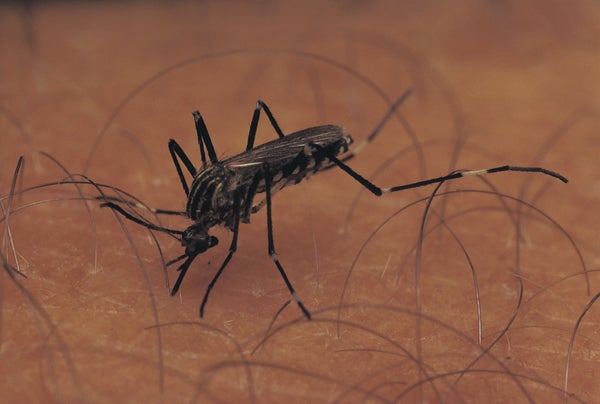

It may sound strange, but scientists are celebrating the survival and spread of tens of thousands of mosquitoes they released in Northeastern Australia. The whole thing makes more sense when you know that these mosquitoes are not just any run-of-the-mill bloodsuckers. They’re weaponized—infected with a type of bacteria that prevents the spread of Zika, dengue and other mosquito-borne viruses.
The bacterium, called Wolbachia, is present naturally in nearly two-thirds of all insect species, although it’s not usually found in Aedes aegypti, the mosquito responsible for spreading Zika, dengue, yellow fever and chikungunya.
But when researchers introduced Wolbachia into mosquitoes in the lab a decade ago, the bacteria bollixed the skeeters, making them unable to transmit their viruses to humans. Which gives public health experts hope that by releasing big groups of Wolbachia-infected mosquitoes into problem areas, they’ll spread Wolbachia to the local populations—making them incapable of transmitting viral diseases to people.
On supporting science journalism
If you're enjoying this article, consider supporting our award-winning journalism by subscribing. By purchasing a subscription you are helping to ensure the future of impactful stories about the discoveries and ideas shaping our world today.
But a big question was, will the weaponized mosquitoes remain contained where they’re let loose, or will they move enough to mingle with their wild brethren?
So researchers in Australia ran a test. In 2013, they released some 35,000 Wolbachia-carrying Aedes aegypti at one site, 131,000 at a second site, and 286,000 at a third site, all in the city of Cairns. And they tracked the insects’ dispersal. Seems the souped-up skeeters spread outward from the two larger introduction areas at a slow but steady rate of about 100 to 200 meters per year. The mosquitoes in the smaller group stayed put. The study is in the journal PLoS Biology. [Tom L. Schmidt et al., Local introduction and heterogeneous spatial spread of dengue-suppressing Wolbachia through an urban population of Aedes aegypti]
The results indicate that Wolbachia-infected mosquitoes could be effective against viral diseases, if—like bug spray—they’re applied liberally over larger areas. In the public health community, that finding may cause a real buzz.
—Karen Hopkin
[The above text is a transcript of this podcast.]
