

When we humans talk to other humans, the sounds we make all have very specific meanings. "When I say apple you immediately imagine something that has the characteristics of an apple." Yossi Yovel, a neuroecologist at Tel Aviv University in Israel. "And the question is, do animals also have something like that?"
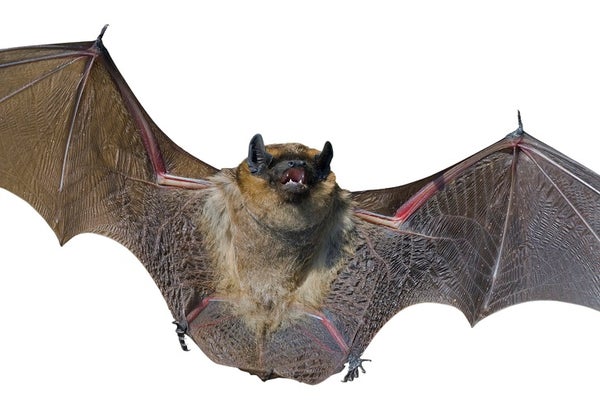
Yovel and his team chose to listen in on bats, which do a lot of vocalizing. In fact, in caves with vast numbers of bats, it's total cacophony. [bat cave] "It sounds like a crowd in a football stadium before the match has begun, or something like that." To simplify the problem, the researchers eavesdropped on a much smaller colony—just 22 Egyptian fruit bats.
Over several months, they recorded tens of thousands of calls, [call] along with synced-up video—which allowed them to decipher the speaker, the intended recipient, the situation, and the behavior resulting from each call. They then fed their huge database of calls to computers, to test whether machine learning could help make sense of them, using algorithms like the ones used for human speech recognition.
On supporting science journalism
If you're enjoying this article, consider supporting our award-winning journalism by subscribing. By purchasing a subscription you are helping to ensure the future of impactful stories about the discoveries and ideas shaping our world today.
Turns out, the algorithms could correctly identify which bat made each call, more often than chance would predict. "And I can say to some extent who is this bat shouting at, so who is the addressee of this vocalization?" They could even figure out what a bat might be angry about, like “hey, that’s my spot, or gimme some space] and how the addressee might respond—meaning there's really quite a lot of information embedded in bat vocalizations. Pretty useful, if you live in the dark. The study is in the journal Scientific Reports. [Yosef Prat, Mor Taub & Yossi Yovel, Everyday bat vocalizations contain information about emitter, addressee, context, and behavior]
As for whether we might someday have Google Translate for bat calls? "Well, Google, definitely not… but perhaps an iPhone." But seriously, "For sure in the next 100 years we will always be behind, we will never really be able to generate a bat to human dictionary. But definitely we will advance in that direction." And in doing so—it might shed a little light on animal communication in general. And how our own language evolved.
—Christopher Intagliata
[The above text is a transcript of this podcast.]
