
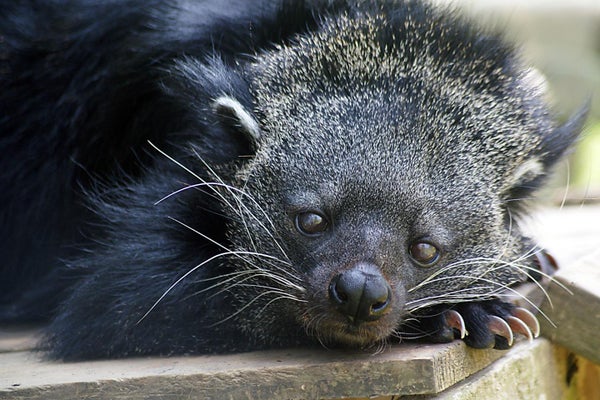

Chances are you’ve never seen a binturong. It’s a tree-dwelling mammal about the size of a raccoon that’s native to Southeast Asia. But if you’ve ever been to the movies, you’d be familiar with their scent. That’s because binturongs smell like freshly cooked popcorn. And now, in a major advance in research connecting animal odors to human recreational venues, researchers know why.
In the wild, binturongs, also called bearcats, are thought to spend most of their time alone. So to communicate with potential mates—or rivals—they leave behind aromatic messages. Although to you and me their musk evokes a matinee, to other animals it reads pure binturong. But previous studies of the animals’ scent glands failed to find chemicals that could account for the distinctive stank. Desperate for an answer, the researchers opted to peruse some pee.
They ever-so-gently squeezed 33 sedated binturongs at a North Caroline wildlife sanctuary to produce urine for analysis. And they discovered that the samples contained a compound called 2-acetyl-1-pyrroline, or 2-AP—which is the very same chemical that lends its distinctive scent to popcorn, as well as to some rice and breads. The finding is served up in the journal Naturwissenschaften, or The Science of Nature. [Lydia K. Greene et al, Reproductive endocrine patterns and volatile urinary compounds of Arctictis binturong: discovering why bearcats smell like popcorn]
On supporting science journalism
If you're enjoying this article, consider supporting our award-winning journalism by subscribing. By purchasing a subscription you are helping to ensure the future of impactful stories about the discoveries and ideas shaping our world today.
Popcorn gets its 2-AP from the Maillard reaction, chemistry that occurs as corn kernels heat up. But for bearcats, who don’t have access to an air popper, it’s probably the bacteria present on their fur or in their intestines that help cook up their signature scent—the researchers confirmed that the animals don’t get their 2-AP from their diet, which, in captivity, includes kibbles and mice.
When binturongs go wee, they tend to soak their tails and feet, which ensures that they leave behind a trail of odiferous information about their species, sex, and reproductive readiness. Of course, if you find yourself in binturong country, remember: that ain’t popcorn you smell. So don’t lick your fingers.
—Karen Hopkin
[The above text is a transcript of this podcast.]
