
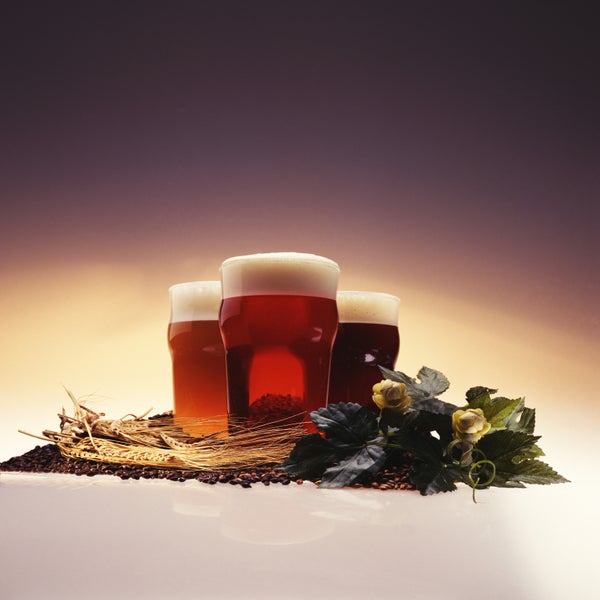

The Allagash Brewing Company, in Maine, makes a lot of "bottle-conditioned" beers—brews that get their carbonation by fermenting a second time, in the bottle, as yeast belch out CO2.
"And because they do bottle conditioning they're meticulous about monitoring package pressures. It's a way for them to follow the progression of this re-fermentation in the bottle." Thomas Shellhammer is a brewing scientist at Oregon State University. Who freely acknowledges: "It's a fun job. Science and beer."
At any rate, not long ago, Allagash noticed some very high pressures in some of their bottles. Not quite exploding. But alarming enough for them to give Shellhammer a call.
On supporting science journalism
If you're enjoying this article, consider supporting our award-winning journalism by subscribing. By purchasing a subscription you are helping to ensure the future of impactful stories about the discoveries and ideas shaping our world today.
What he and his colleague Kaylyn Kirkpatrick found was that hops—the bittering agent in beers—might be to blame. Because the aromatic flowers contain enzymes that can chew up starch. Typically, when hop flowers are added during the initial cooking of the fermentable brew, those key enzymes are denatured. And thus the flowers' only role is as a flavoring agent.
But as the demand for hoppy beers has grown, brewers have been looking for other tricks to get those juicy, fruity, herbal aromas into beers. So they've been what’s called "dry-hopping" beers—dumping loads of hops into the beer during or after fermentation, rather than during the initial boil.
"There's an upward limit to how much hops you'd want to put in the kettle because the beers just get unpalatably bitter. But if a brewer focuses on dry hopping they can put very large amounts of hops into beer to create intense hoppy flavors."
Problem is, adding hops late doesn't deactivate their starch-attacking enzymes. And they're able to break down starches the yeasts weren't able to attack, unleashing even more sugar into the brew. And if yeast are still hanging out, as in Allagash's bottle-conditioned beers, that kickstarts additional fermentation. And that boosts alcohol by volume and carbon dioxide concentration—to potentially explosive levels.
"Basically the hops are taking something that's considered by brewers to be unfermentable, and breaking them down to the point where they can actually re-ferment, or become fermentable, or potentially contribute to sweetness, as beer ages."
The full detective story is in the Journal of Agricultural and Food Chemistry. [Kaylyn R. Kirkpatrick and Thomas H. Shellhammer, Evidence of Dextrin Hydrolyzing Enzymes in Cascade Hops (Humulus lupulus)]
And, in case you're wondering, Shellhammer's palate does align with his academic interests: "I'm kind of intrigued by the hazy, juicy IPA thing that's going on right now. I'm also a fan of sort of traditional old school IPAs." He’s the rare professor whose students use IPAs to raise their GPAs.
—Christopher Intagliata
[The above text is a transcript of this podcast.]

