New Issue: Orbital Catastrophe Ahead? Read Now

Bees Prefer Flowers That Proffer Nicotine

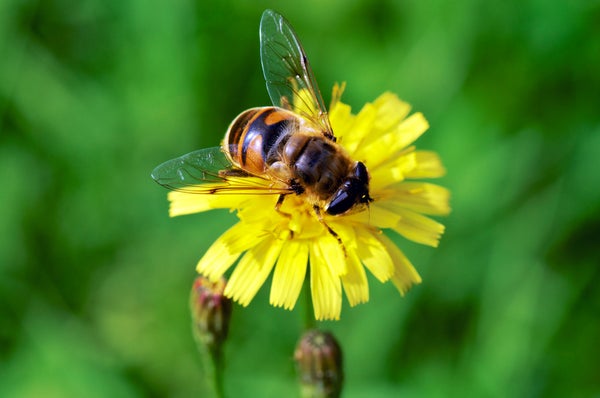
Bumblebees sought out flowers with nicotine in their nectar, and the drug appeared to enhance the bees' memories. Christopher Intagliata reports.

Getty Images/iStockphoto/Thinkstock

Illustration of a Bohr atom model spinning around the words Science Quickly with various science and medicine related icons around the text

Join Our Community of Science Lovers!

We humans enjoy coffee and tea, to give our brains a caffeine boost. And bees sometimes sip nectar that naturally contains caffeine, which seems to enhance their memory. Now a study suggests that bees enjoy another familiar drug produced by plants: nicotine.

"As it turns out, not just in humans, but even the bees seem to have difficulties quitting." Lars Chittka, a professor of behavioral and sensory ecology at Queen Mary University of London. 

Chittka and his colleagues studied bumblebees as they visited fake flowers that contained varying levels of nicotine. Unnaturally high nicotine concentrations deterred the bees. But at real-world levels, the drug attracted bees. And they even learned a flower's color faster, if that flower offered a nicotine fix.


On supporting science journalism

If you're enjoying this article, consider supporting our award-winning journalism by subscribing. By purchasing a subscription you are helping to ensure the future of impactful stories about the discoveries and ideas shaping our world today.


Sometimes bees paid a steep price for this preference. "They returned actually to flowers that had previously sold them nicotine, so to speak, even if these flowers no longer contained nectar." 

Which might give nicotine-pushing plants, like tobacco, an edge. "It provides these plant species with an unfair advantage over competing plants, because they can retain the faithful services of pollinators, even if they're offering suboptimal nectar in this case." 

The results are in the journal Scientific Reports. [D. Baracchi et al., Nicotine in floral nectar pharmacologically influences bumblebee learning of floral features]

And if caffeine and nicotine have these effects on bees? Perhaps natural floral pharmacies stock other drugs too—that enhance pollination, and give bees a buzz.

—Christopher Intagliata

[The above text is a transcript of this podcast.]

Subscribe to Support Independent Journalism

Great science journalism requires human expertise, time, effort and creativity. And it costs money. That’s why I and the journalists here at Scientific American hope you’ll join our community.

When you subscribe, you are supporting staff and freelance journalists who are passionate about telling science stories that are true, important and compelling. Our editors and reporters are often experts in their fields, which means they understand the nuances of big discoveries and can untangle the breakthroughs from the hype. With a subscription, you are also supporting rigorous fact-checking to ensure the words we publish are precise and accurate. And you’re supporting original illustrations, graphics and photos that bring you closer to an advanced laboratory, an ice sheet in Antarctica or a space mission in orbit. You’re helping us craft other types of high-quality journalism as well: Our newsletters are carefully written, edited and curated by staffers you have or will come to know and love. Our Science Quickly podcast is based on original reporting, collaboration with editors and scientists and exacting production.

Subscriptions keep this engine running so we can continue to deliver thoughtful, rigorous and independent science journalism to you. In an era of viral misinformation, this work is crucial. If you value what we do, I hope you’ll consider joining us as a subscriber

Thank you,

Jeanna Bryner, Editor in Chief, Scientific American

Subscribe