
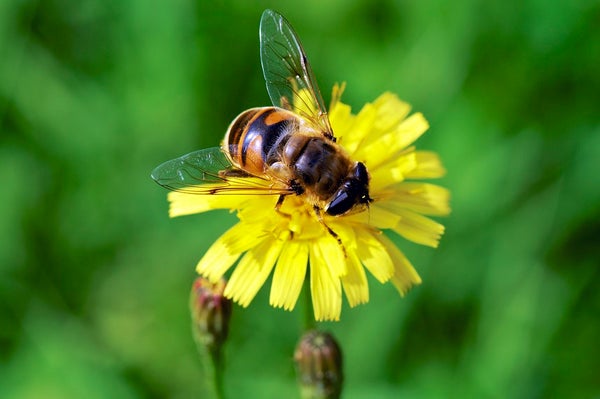

Walk through Times Square—you're bombarded with advertising. And it turns out, a bumblebee might have a similar feeling, buzzing through a field of flowers. "So these flowers are these billboards, they're advertising a good, this delicious nectar reward, and bees are very picky shoppers." Anne Leonard, a pollination biologist at the University of Nevada, Reno.
She describes a flower field as a sort of pollination marketplace. And one way bees choose where to visit? "Bees are nectar experts. They are really good at assessing even really small differences in the sugar concentration of nectar." They also scope out flower shape and size, color and scent. And now Leonard and her colleagues have discovered that bumblebees are pollen aficionados, too.
They found that out by lacing batches of cherry pollen with either table sugar or bitter quinine. And to display the pollen to bees, "We got really into it—we started 3-D printing flowers in our lab." And for the anther—the male flower part, which presents the pollen—pipe cleaners. "So we bought out Michael's craft store supplies of these pipe cleaners and used them in our experiments."
On supporting science journalism
If you're enjoying this article, consider supporting our award-winning journalism by subscribing. By purchasing a subscription you are helping to ensure the future of impactful stories about the discoveries and ideas shaping our world today.
Turns out bees would return again and again to the same color flower that dispensed sweet pollen, and spend more time collecting there. But when confronted with the bitter pollen? They sought a different colored flower for their very next stop. All of which suggests that, in addition to savoring nectar, bees taste pollen too—and judge flowers by it. The results are in the journal Biology Letters. [Felicity Muth, Jacob S. Francis and Anne S. Leonard, Bees use the taste of pollen to determine which flowers to visit]
The finding means that plants have to find a happy medium: "So can you make your pollen attractive enough that the bees will collect it, but distasteful enough that they won't collect too much of it?" And that balancing act, of carefully calibrated chemistry—it's just one of the many transactions that plays out in the buzzing pollination marketplace. Where the object is to make a sweet profit.
—Christopher Intagliata
[The above text is a transcript of this podcast.]
