
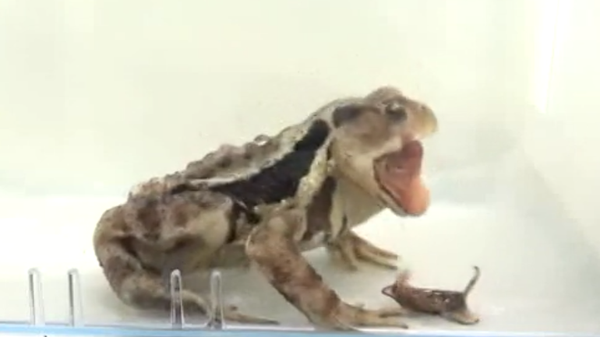

If you’re a fan of nature shows, you’ve probably heard of the bombardier beetle. When disturbed, this weaponized insect can spray a boiling hot jet of noxious chemicals from its hind end—a response that even the hungriest predators find highly off-putting.
But what if that predator is so stealthy and quick that the beetle doesn’t have time to deploy its signature defense before it gets ‘et? Turns out, the explosion is also effective when detonated from the inside. We know this because a new study shows that the bombardier beetles can use their chemical weapons to escape from the belly of the toad that ate them. They accomplish this Jonah-like feat by using their chemical cocktail to encourage the amphibian to barf them back up. The finding is served up in the journal Biology Letters. [Shinji Sugiura and Takuya Sato, Successful escape of bombardier beetles from predator digestive systems]
Researchers collected 37 beetles and 37 toads from a forest in Central Japan. Some of the toads, those of the species Bufo japonicas, share their territory with the bombardier beetles. Others, the Bufo torrenticola, inhabit the nearby streams and don’t normally encounter these feisty bugs.
On supporting science journalism
If you're enjoying this article, consider supporting our award-winning journalism by subscribing. By purchasing a subscription you are helping to ensure the future of impactful stories about the discoveries and ideas shaping our world today.
Back in the lab, the researchers paired off their collected specimens and each toad was allowed to capture and swallow a single beetle. And then came the fireworks. As the authors note in their paper: “an explosion was audible inside each toad.” Which means that somewhere along the alimentary canal, the beetles dropped their bombs.
What happened next depended on the participants. About 35 percent of the japonicas toads, who presumably were familiar with the beetles, spit the critters back up. While 58 percent of the stream toads gave the researchers valuable feedback, literally—they upchucked, too.
As for the bugs, the larger ones were more likely to make it back out. The lucky ones escaped in under 15 minutes. And those less fortunate were in there up to an hour and a half. And though they emerged covered in mucus, all 16 vomited beetles returned alive and were able to walk away. Fifteen of them were still kicking two weeks later. And one survived to tell his tale for another a year and a half.
And it was largely their emetic emissions that saved them. Bugs who were prodded into depleting their chemical arsenals before they got eaten were never seen—or heard from—again. The authors note that “no toads died as a result of swallowing beetles.” But after their contribution to science, they probably avoided hot sauce.
—Karen Hopkin
[The above text is a transcript of this podcast.]
