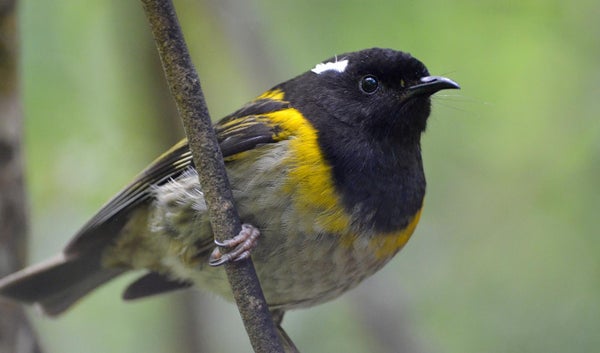
For more than a hundred years, this sound has been missing from New Zealand's forests: "It's like two stones being clicked together, or two marbles being clicked together. It's a very simple call." Oliver Metcalf, a conservation biologist at Manchester Metropolitan University, has studied the small bird that makes the noise—the hihi. By the 1880s, it was all but wiped out by rats and disease, which came along with colonists.
But the hihi did manage to survive on a predator-free barrier island called Te Hauturu-o-Toi. And now they're being reintroduced to mainland New Zealand. "And they're going through the process of trying to restore the ecosystems they had prior to colonial settlement there. So they're bringing back the birds one by one."
But the dense forests, and the birds' unusual behavior, makes them tough to monitor. "They're very inquisitive—they love people! So they'll come and see you. If they hear you coming, they'll come and see you. But that means you have a problem of knowing what they would have been doing when you're not there."
On supporting science journalism
If you're enjoying this article, consider supporting our award-winning journalism by subscribing. By purchasing a subscription you are helping to ensure the future of impactful stories about the discoveries and ideas shaping our world today.
So instead, Metcalf and his collaborators from the Zoological Society of London used that distinctive call to their advantage—using an array of audio recorders to eavesdrop on 40 hihi birds reintroduced to the North Island's Rotokare Scenic Reserve. A month later, analysis of the calls revealed that the birds had abandoned some areas of the reserve, and settled into others… suggesting they'd begun to form territories, often close to water.
The details are in the journal Methods in Ecology and Evolution. [Oliver C. Metcalf et al., A novel method for using ecoacoustics to monitor post-translocation behaviour in an endangered passerine]
Metcalf says the concept could be used to monitor all sorts of animals. "So whether that's a reintroduction of a small mammal, or how existing birds species respond to a housing development nearby or something like that, this process could be used to understand how those populations respond to changes."
Assuming, that is, they make some noise.
—Christopher Intagliata
[The above text is a transcript of this podcast.]
Subscribe to Support Independent Journalism
Great science journalism requires human expertise, time, effort and creativity. And it costs money. That’s why I and the journalists here at Scientific American hope you’ll join our community.
When you subscribe, you are supporting staff and freelance journalists who are passionate about telling science stories that are true, important and compelling. Our editors and reporters are often experts in their fields, which means they understand the nuances of big discoveries and can untangle the breakthroughs from the hype. With a subscription, you are also supporting rigorous fact-checking to ensure the words we publish are precise and accurate. And you’re supporting original illustrations, graphics and photos that bring you closer to an advanced laboratory, an ice sheet in Antarctica or a space mission in orbit. You’re helping us craft other types of high-quality journalism as well: Our newsletters are carefully written, edited and curated by staffers you have or will come to know and love. Our Science Quickly podcast is based on original reporting, collaboration with editors and scientists and exacting production.
Subscriptions keep this engine running so we can continue to deliver thoughtful, rigorous and independent science journalism to you. In an era of viral misinformation, this work is crucial. If you value what we do, I hope you’ll consider joining us as a subscriber