
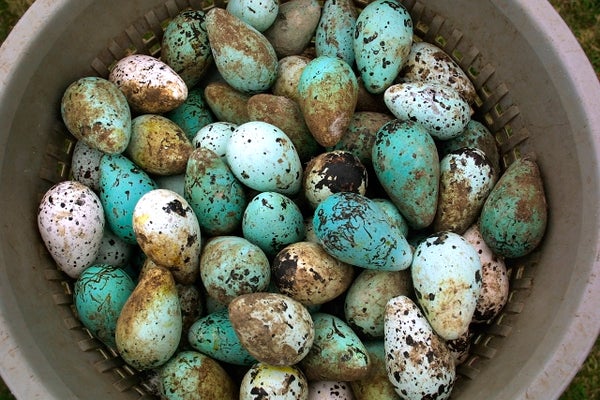

Most supermarket eggs look pretty boring. Plain white chicken eggs; brown ones if you’re lucky. However:
“There’s a couple breeds that have blue eggs. And you can buy them at Whole Foods, actually.”
Daniel Hanley, an evolutionary ecologist at Long Island University—who has a very specific reason for caring about the color of his eggs.
On supporting science journalism
If you're enjoying this article, consider supporting our award-winning journalism by subscribing. By purchasing a subscription you are helping to ensure the future of impactful stories about the discoveries and ideas shaping our world today.
“I’m always thinking about eggs. It’s one of the tools I use to understand ecological and evolutionary processes. I study the function and evolution of natural colors. And the main system I use are birds eggs.”
Unlike white supermarket eggs, most bird eggs are colored various shades of bluish-green or brown due to two characteristic pigments birds produce. And by examining the egg colors of 634 species from around the world, Hanley and his colleagues found a curious pattern.
“In the northern climates, where it’s the coolest, eggs are darker and browner. And those colors should give some type of adaptive benefit to those parents to be off of their eggs for a slightly longer period of time.”
Darker eggs, in theory, would absorb more of the scarce sunlight in the Arctic, keeping the eggs warmer and allowing their parents to spend more time away from the nest, looking for food. And indeed, when Hanley’s team left 66 differently colored duck, quail and chicken eggs in the sun, they found that the darker the eggs, the more slowly they lost their heat.
The details and a world map of egg colors are in the journal Nature Ecology & Evolution. [Phillip A. Wisocki et al., The global distribution of avian eggshell colours suggest a thermoregulatory benefit of darker pigmentation]
And if you’re wondering “Are dark brown chicken eggs from some ancestral arctic chicken?”
“No, no, no, no.”
They just come from a different breed of hen. One that maybe prefers to buck the trend.
—Christopher Intagliata
[The above text is a transcript of this podcast.]
