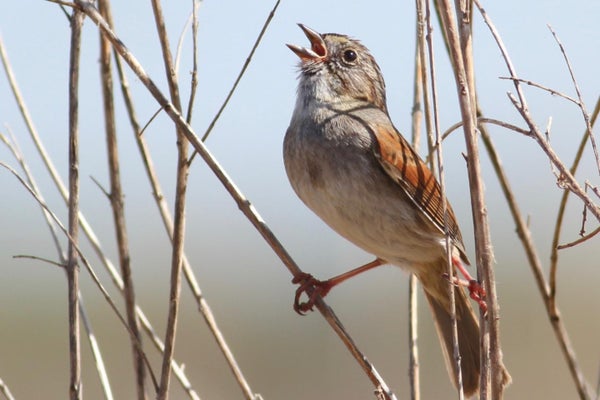
Bird's Song Staying Power Implies Culture

Certain motifs in swamp sparrow songs can last hundreds, even thousands of years—evidence of a cultural tradition in the birds. Christopher Intagliata reports.

Illustration of a Bohr atom model spinning around the words Science Quickly with various science and medicine related icons around the text

Join Our Community of Science Lovers!

Travel the U.S. and you'll hear English spoken in a multitude of ways. And it turns out the same can go for songbirds—specifically the swamp sparrow.

Scientists have now used those swamp sparrow regional "dialects," together with computer simulations, to extrapolate how the sparrow's songs have changed and evolved over time. And they found that certain song motifs could date back hundreds, even thousands of years. 

"That's where, frankly, it blew me away, I have to say." Steve Nowicki, a biologist at Duke University. "If Leif Erikson had taken time once he discovered North America to get as far in as northwestern Pennsylvania, where I just was last week, he would have heard some—not many, but some of the same song types I was just listening to."


On supporting science journalism

If you're enjoying this article, consider supporting our award-winning journalism by subscribing. By purchasing a subscription you are helping to ensure the future of impactful stories about the discoveries and ideas shaping our world today.


The study is in the journal Nature Communications. [Robert F. Lachlan, Oliver Ratmann & Stephen Nowicki, Cultural conformity generates extremely stable traditions in bird song]

Passing learned information from generation to generation—that sounds a lot like culture.  

"It is culture. These birds are showing a persistence of cultural tradition that is heretofore unknown and matches that of the best cultural persistence we might see in human culture."

But sparrows aren't as cognitively complex as humans, he says, implying that you don’t need human-type smarts to develop cultural traditions.

—Christopher Intagliata

[The above text is a transcript of this podcast.]

It’s Time to Stand Up for Science

If you enjoyed this article, I’d like to ask for your support. Scientific American has served as an advocate for science and industry for 180 years, and right now may be the most critical moment in that two-century history.

I’ve been a Scientific American subscriber since I was 12 years old, and it helped shape the way I look at the world. SciAm always educates and delights me, and inspires a sense of awe for our vast, beautiful universe. I hope it does that for you, too.

If you subscribe to Scientific American, you help ensure that our coverage is centered on meaningful research and discovery; that we have the resources to report on the decisions that threaten labs across the U.S.; and that we support both budding and working scientists at a time when the value of science itself too often goes unrecognized.

In return, you get essential news, captivating podcasts, brilliant infographics, can't-miss newsletters, must-watch videos, challenging games, and the science world's best writing and reporting. You can even gift someone a subscription.

There has never been a more important time for us to stand up and show why science matters. I hope you’ll support us in that mission.

Thank you,

David M. Ewalt, Editor in Chief, Scientific American

Subscribe