
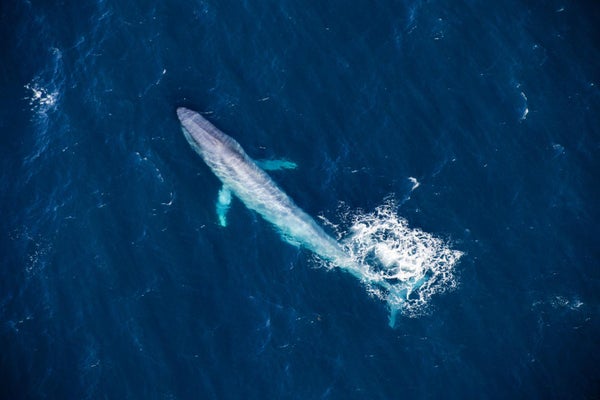

Blue whales are the largest animals ever to exist on Earth. But they're still tough to track. Because they live underwater where we can't easily see them--and often in remote areas, like the southern ocean. But the whales' songs can travel hundreds of kilometers underwater… so scientists often listen for them instead.
But these eavesdropping biologists have noticed a mysterious trend: that certain blue whale calls are gradually lowering in pitch, over time. For example, here's a call from 2002, followed by one from 2017. <2002–2017 call>
"It has been observed in blue whale populations worldwide. So this phenomenon has to have a worldwide explanation." Emmanuelle Leroy is a bioacoustician at the University of New South Wales in Australia, who did the work at the University of Brest in France.
On supporting science journalism
If you're enjoying this article, consider supporting our award-winning journalism by subscribing. By purchasing a subscription you are helping to ensure the future of impactful stories about the discoveries and ideas shaping our world today.
Her team confirmed the phenomenon holds true for populations of blue whales in the southern Indian Ocean, too. And they suggest one reason may be that whale numbers have rebounded from the days of Captain Ahab. More whales means individuals don't have to shout as loud to be heard by other whales. And because of an anatomical peculiarity in the way whales sing, the softer they sing, the lower the pitch.
The scientists have another theory, too, which may be acting in concert with the first: which is that whales are singing more softly—and therefore more deeply—because increasingly acidic ocean waters carry their calls farther. The full write-up is in the Journal of Geophysical Research: Oceans. [Emmanuelle C. Leroy et al., Long‐Term and Seasonal Changes of Large Whale Call Frequency in the Southern Indian Ocean]
Leroy and her team noticed one other short-term trend: that southern blue whales' songs actually get higher in pitch during the Austral summer. Perhaps in an effort to be heard over cracking icebergs.
"Like when you put an ice cube in your drink, you can hear it crack. So it's the same for an iceberg - so it will be really loud and you can hear it across an oceanic basin."
To solve these mysteries more definitively, the scientists say that we'll need to keep listening, and monitor the changing chemical and acoustic properties of the oceans. To see which of these ideas are borne out. And which don't hold water.
—Christopher Intagliata
[The above text is a transcript of this podcast.]
