

To study the heavens, it's all about the photons. "We in astronomy are always greedy. We want every photon we can collect." Drew Phillips, astronomer at University of California Observatories. More photons, he says, basically means more science about incredibly faint, distant objects.
And that's where the optics problem comes in. Because incoming light reflects off several mirrors before it comes out the business end of a telescope. And mirrors aren't perfectly reflective. The traditional mirror coating, aluminum, reflects only about 90 percent of light. Bounce that light around a few times in a telescope, and you lose valuable photons.
"The throughput, the actual number of photons that are detected in the end in a modern spectrograph, you're doing good if you get thirty percent."
On supporting science journalism
If you're enjoying this article, consider supporting our award-winning journalism by subscribing. By purchasing a subscription you are helping to ensure the future of impactful stories about the discoveries and ideas shaping our world today.
So you want the most reflective material for your mirrors. Like silver, which reflects 97 to 99 percent of visible and infrared light, respectively. Big improvement over aluminum. But silver's got problems too. "It is finicky. It's subject to tarnish, and oxidation, and corrosion."
So Phillips and his team have borrowed a trick from the computer industry, called atomic layer deposition. The technique allows them to take a silver-coated mirror—and coat it with extremely uniform layers of transparent aluminum oxide, to protect against corrosion.
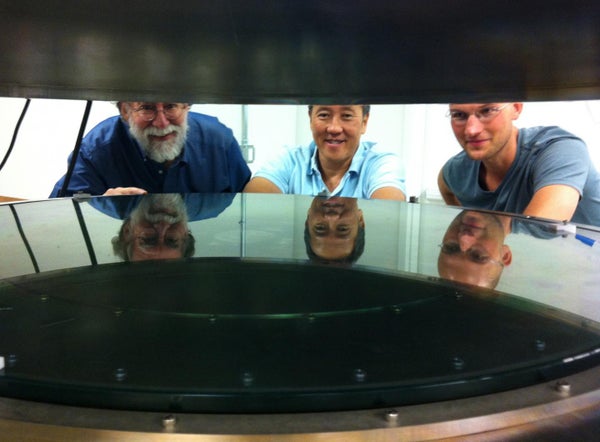
And unlike the small-scale atomic deposition used in the electronics industry, this new machine--recently installed in a lab at U.C. Santa Cruz—is scaled up to coat mirror segments up to a meter in diameter. Meaning you could coat all 500 mirrors of a state-of-the-art telescope—like the planned Thirty Meter Telescope—in a matter of months. [Journal of SPIE]
When put to use, these better mirrors might allow astronomers to capture more photons… and shed more light—literally—on faraway galaxies and stars.
--Christopher Intagliata
[The above text is a transcript of this podcast.]
