
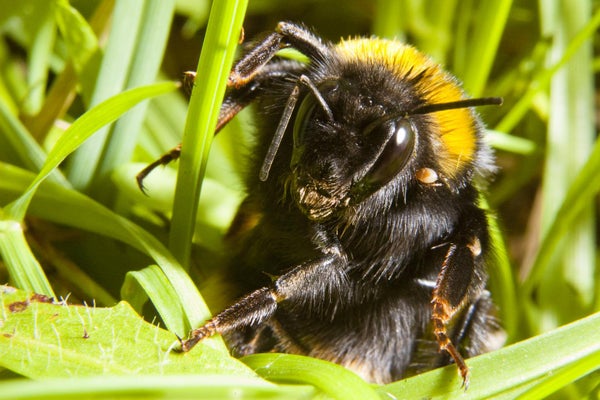

They're furry, fat and hibernate all winter. Not bears—bumblebees. Specifically the queens, which emerge from hibernation in the spring to establish new colonies—a bit of a trek away.
"We knew that queens end up kilometers from the previous year's natal nest site but we didn't know anything about how they get there." Clint Perry, a cognitive biologist at Queen Mary University of London.
To observe that phenomenon in action, he and his team glued antennas to the backs of 20 bumblebee queens, which had been kept under simulated hibernation conditions. The researchers then tracked the insects with radar as they emerged from small dens in the dirt and found that bumblebees take wing for only 10 to 20 seconds before landing for much longer layovers.
On supporting science journalism
If you're enjoying this article, consider supporting our award-winning journalism by subscribing. By purchasing a subscription you are helping to ensure the future of impactful stories about the discoveries and ideas shaping our world today.
"We were all surprised the bees spent so much time resting in the ground and that they seem to sleep for so much time even. I personally found it amusing and cute that they position their bodies so their head was under a leaf or under grass while their butt was still sticking out in the open."
Observations of wild bees confirmed they do this too—and that it wasn't just the transponders affecting the bees' behavior. As for how they wind up kilometers away from the previous year's nest site? Computer modeling suggests even these short random bursts of flight would do the job. The results are in the journal Scientific Reports. [James C. Makinson et al., Harmonic radar tracking reveals random dispersal pattern of bumblebee (Bombus terrestris) queens after hibernation]
The findings suggest some queen-friendly conservation ideas: "It would likely help queen bumblebee survival if we established pollinator-friendly corridors between conserved landscape patches. That means planting more pollinator-friendly flowers and pollinator-friendly trees and flowers year-round.”
The queens also take shelter in long grass and leaf litter, suggesting an intervention closer to home—if you can resist raking, that is.
—Christopher Intagliata
[The above text is a transcript of this podcast.]
