
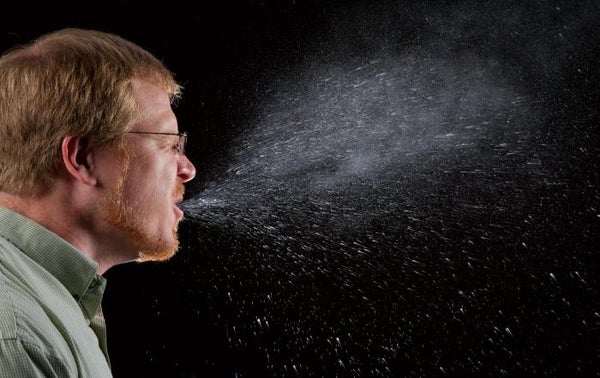

You’re at the supermarket trying to choose a ripe tomato when, behind you, you hear ...
[CLIP: Cough sound]
If you’re like most people, you probably hold your breath, tighten your mask and hope you don’t catch whatever Patient Zero is spraying over the fresh produce. And if you’re like most people, chances are you’re overreacting, because a new study shows that we’re not very skilled when it comes to diagnosing infectiousness based on the sound of a sneeze or cough. The work is in the Proceedings of the Royal Society: Biological Sciences. [Nicholas Michalak et al., Sounds of sickness: Can people identify infectious disease using sounds of coughs and sneezes?]
On supporting science journalism
If you're enjoying this article, consider supporting our award-winning journalism by subscribing. By purchasing a subscription you are helping to ensure the future of impactful stories about the discoveries and ideas shaping our world today.
Previous studies have shown that folks can tell when someone is sick based on how they look or, in some cases, how they smell. So it’s only natural to wonder whether the same would hold true for an assessment with our ears.
So researchers asked volunteers to listen to audio clips of people hacking and sneezing.
“Half of the coughs and sneezes were produced by someone with an infectious illness, like the flu or the common cold. And half were produced by benign causes like eating too much cinnamon all at once or sticking a Q-tip up their noses.”
Nicholas Michalak, a grad student in social psychology at the University of Michigan.
“We clipped these sounds from YouTube videos in which people told their audience that they were sick. Many reported having been diagnosed by a medical professional. All this said, we could not directly confirm whether people in our sound clips were infectious or not.”
And what he found?
“Across four studies of over 600 participants in total, on average, people guessed four out of 10 sounds correctly, which is consistent with random guessing. In other words, they weren’t very good at judging whether the sounds were infected.”
But being bad judges didn’t dampen their confidence. When asked how sure they were about their guesses, on a scale of 1 to 9, participants reported an average certainty of 7.
“Interestingly, we didn’t find any evidence that people who were more certain about their guesses were more or less likely to guess correctly.”
So what made them so sure that certain sounds were sure signs of disease? Well, the sickies, they figured, made noises that seemed the most gross.
“The more disgusting they perceived a sound, the more likely they were to judge it infectious.”
So ...
[CLIP: Noninfectious cough sound]
... might be deemed more contagious than ...
[CLIP: infectious cough sound]
... depending on your own personal nasty-o-meter.
All that’s to say ...
“Even if it seems you can tell whether a cough or sneeze is infectious, based on how disgusting it sounds, that feeling has the potential to mislead you.”
In other words, you can’t judge a bug by its cougher.
—Karen Hopkin
[The above text is a transcript of this podcast.]
