
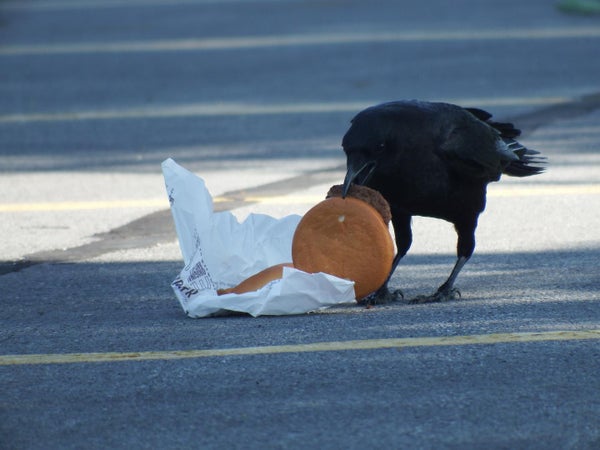

High cholesterol affects a third of American adults. But it’s not just us! Studies have indicated that cholesterol is also on the rise in other animals.
“And in all of these studies, the idea was it was probably due to interactions with people and eating our food. But they didn’t actually show that.”
Andrea Townsend is an avian ecologist at Hamilton College in upstate New York. And she found that urban crows did have higher cholesterol than rural crows.
On supporting science journalism
If you're enjoying this article, consider supporting our award-winning journalism by subscribing. By purchasing a subscription you are helping to ensure the future of impactful stories about the discoveries and ideas shaping our world today.
But then she took the next logical step in her research. She went to McDonald’s. “We’d pick up 125 burgers at a time. Once one of them wanted to know what we needed all these burgers for, and I started to explain, but they just kind of waved me away halfway through.”
Of course, she needed all those cheeseburgers to feed crows and to monitor their diet—to determine if eating our fast food really does raise the birds’ cholesterol.
“So the way you ‘supplement your nestlings’ is: we’d go to their nest trees, we’d toss the cheeseburgers, three to five a day, under their nest trees. The parents would immediately swoop down, pick up the burgers and bring them to their nestlings.”
And as you might expect, crows that dined on cheeseburgers did indeed have higher cholesterol than crows who did without. But here’s the surprising thing: higher cholesterol didn’t affect crows’ chances of survival over a three-year period. And in one population, birds with higher cholesterol were arguably in better condition than other crows. Meaning chubbier.
The results are in the journal the Condor. [Andrea K. Townsend et al., Urbanization and elevated cholesterol in American crows]
Crows can live more than 15 years, and Townsend says maybe a high-cholesterol diet makes its mark later in life, as it does in humans. And if you’re still wondering, “Why study this?”
“But I would say this is an important question, because there are lots of other species that also live in urban areas and eat our food. And some of them are endangered. So it is an important question: How will our food affect the health of wild animals?”
And as we urbanize more of the globe, our dietary influence might have even wider effects.
As for Townsend, crows are known to be highly skilled at recognizing humans, and she says the study made her a celebrity.
“During this study, especially when I was walking around, the crows would follow me around campus. They often just follow me around campus; they follow my car. I was getting some notoriety on a broader scale with crows. I’d be getting gas, and the crows in the gas station would be cawing a special caw just for me. It seemed like a recognition caw. So it’s like ‘caw caw caw.’”
After all, a free lunch seems like something to squawk about.
—Christopher Intagliata
[The above text is a transcript of this podcast.]
