Chromosomes Combat Counterfeit Caviar

Researchers found unique genetic variants that differentiate costly beluga caviar from cheaper fakes that rip off consumers. Christopher Intagliata reports.

PhotoDisc/Getty Images

Illustration of a Bohr atom model spinning around the words Science Quickly with various science and medicine related icons around the text

Join Our Community of Science Lovers!

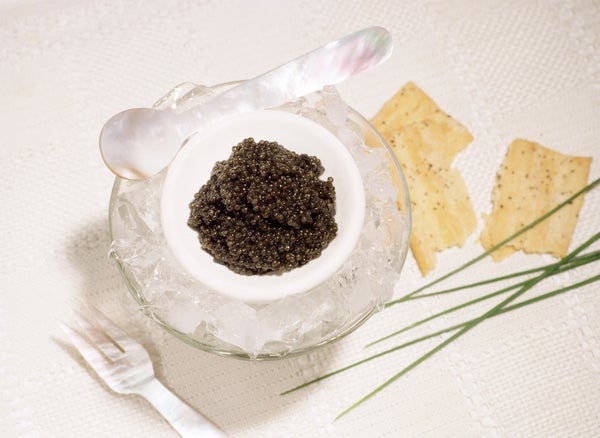
Caviar is one of the world's priciest foods: it can cost thousands of dollars a pound. And caviar from the beluga sturgeon is the most exclusive of all. But even experts have a hard time telling the eggs from two different species apart by appearance alone. 

So scientists came up with a method that more than meets the eye: a genetic test that identifies variations in nuclear DNA that are unique to the beluga and its cousin, the sterlet. The test can differentiate roe of those two species from that of eight other species of sturgeon. 

And the best part, given caviar's premium price? The test requires just a single egg. The study is in the journal Scientific Reports. [Miloš Havelka et al., Nuclear DNA markers for identification of Beluga and Sterlet sturgeons and their interspecific Bester hybrid]


On supporting science journalism

If you're enjoying this article, consider supporting our award-winning journalism by subscribing. By purchasing a subscription you are helping to ensure the future of impactful stories about the discoveries and ideas shaping our world today.


The researchers say that by definitively identifying the real stuff, the test could prop up its high price. But this effort is not just of interest to the 1-percenters: genetic verification could also be used for conservation. Belugas are critically endangered. And since they hybridize with other sturgeon species, conservationists need to make sure that farm-raised fish they plan to reintroduce into the wild are the real thing, and not just a cheap lookalike.

—Christopher Intagliata

[The above text is a transcript of this podcast.]

It’s Time to Stand Up for Science

If you enjoyed this article, I’d like to ask for your support. Scientific American has served as an advocate for science and industry for 180 years, and right now may be the most critical moment in that two-century history.

I’ve been a Scientific American subscriber since I was 12 years old, and it helped shape the way I look at the world. SciAm always educates and delights me, and inspires a sense of awe for our vast, beautiful universe. I hope it does that for you, too.

If you subscribe to Scientific American, you help ensure that our coverage is centered on meaningful research and discovery; that we have the resources to report on the decisions that threaten labs across the U.S.; and that we support both budding and working scientists at a time when the value of science itself too often goes unrecognized.

In return, you get essential news, captivating podcasts, brilliant infographics, can't-miss newsletters, must-watch videos, challenging games, and the science world's best writing and reporting. You can even gift someone a subscription.

There has never been a more important time for us to stand up and show why science matters. I hope you’ll support us in that mission.

Thank you,

David M. Ewalt, Editor in Chief, Scientific American

Subscribe