
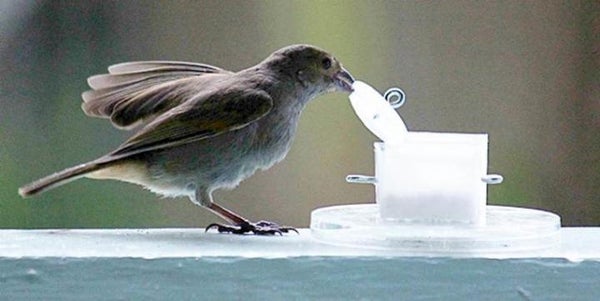

City dwellers can attest that the animals they share the city with—the pigeons, rats, roaches—can be pretty brazen when they're prowling for a bite. While visiting Barbados, McGill University neurobiologist Jean-Nicolas Audet, noticed that local bullfinches were accomplished thieves.
"They were always trying to steal our food. And we can see those birds entering in supermarkets, trying to steal food there." And that gave him an idea. "Since this bird species is able to solve amazing problems in cities, and they're also present in rural areas, we were wondering" are the rural birds also good problem-solvers, and they just don't take advantage of their abilities? Or are they fundamentally different?
So Audet and his McGill colleagues captured Barbados bullfinches, both in the island's towns and out in the countryside. They then administered the bird equivalent of personality and IQ tests: assessing traits like boldness and fear, or timing how quickly the finches could open a puzzle box full of seeds. And it turns out the city birds really could solve puzzles faster. They were bolder, too, except when it came to dealing with new objects—perhaps assuming, unlike their more naive country cousins, that new things can either mean reward…or danger. The study is in the journal Behavioral Ecology. [Jean-Nicolas Audet et al, The town bird and the country bird: problem solving and immunocompetence vary with urbanization]
On supporting science journalism
If you're enjoying this article, consider supporting our award-winning journalism by subscribing. By purchasing a subscription you are helping to ensure the future of impactful stories about the discoveries and ideas shaping our world today.
The city birds bested their country counterparts in another trait: they have more robust immune systems, possibly from scavenging food and water in dirty places. Which suggests that sometimes, a city's dirt and grit could be the very thing that gives avian residents a wing up.
—Christopher Intagliata
[The above text is a transcript of this podcast.]
