
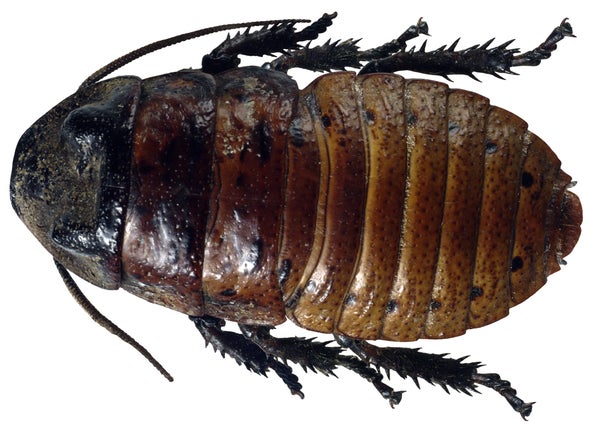

Microbes play a huge role in our nutrition, our immunity, maybe even our mental health. But we aren’t the only ones that rely on these armies of resident bacteria. "Baby cockroaches, the ones that just emerge from the egg, don't have any gut bacteria." Coby Schal, an entomologist and chemical ecologist at North Carolina State University. "The first thing they do is take a nice feces meal: basically, eating the poop of their brothers and sisters and mothers and fathers."
Excrement inoculates the roaches with beneficial gut bugs, Schal says. And it's also a longevity-boosting nutritional supplement. But the weirdest thing is, the poop actually calls the tots to come hither. Because it's laced with compounds, like fatty acids, that attract roaches of all ages. The substances are called aggregation pheromones. So poop essentially serves as a rallying call to congregate—and feast.
To determine where the attractive chemicals come from, Schal and his colleagues raised a group of sterile, microbe-free cockroaches—and then collected their excrement. But as they suspected, the sterile stuff, without any microbial by-products, failed to tantalize other roaches. They then gave the sterile bugs a fecal transplant. "So we took feces of normal cockroaches, and exposed sterile cockroaches to those feces. They very readily eat these feces and they incorporate the microbes, the bacteria from these feces, into their gut. And then these cockroaches then produce the aggregation pheromone again." They published the findings in the Proceedings of the National Academy of Sciences. [Ayako Wada-Katsumata et al, Gut bacteria mediate aggregation in the German cockroach]
On supporting science journalism
If you're enjoying this article, consider supporting our award-winning journalism by subscribing. By purchasing a subscription you are helping to ensure the future of impactful stories about the discoveries and ideas shaping our world today.
The results suggest gut bacteria may do a lot more than we thought—including, at least for cockroaches, aid communication. That's a plus for us—because we might be able to hijack those compounds to build better baits and traps. To make sure that [Clip from commercial: "Roaches check in… but they don't check out."]
—Christopher Intagliata
[The above text is a transcript of this podcast.]
