
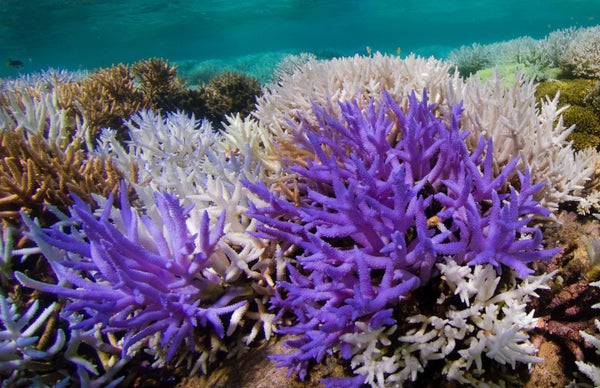

Warmer oceans are putting stress on corals—and causing many of them to turn white, or bleach. But some corals under stress are instead becoming strangely colorful, turning brilliant neon pink, yellow, purple or blue.
“They give this very vibrant coloration, which really blows you away.”
Jörg Wiedenmann heads the University of Southampton’s Coral Reef Laboratory in the U.K. He said he was seeing photos and reports of these brightly colored corals—but no one knew what was happening. So his lab experimentally bleached corals to find out.
On supporting science journalism
If you're enjoying this article, consider supporting our award-winning journalism by subscribing. By purchasing a subscription you are helping to ensure the future of impactful stories about the discoveries and ideas shaping our world today.
First, though, it’s important to understand that corals aren’t really a single organism. They’re a symbiotic duo, a partnership, between an algae and a coral.
“So it’s two completely different organisms working together to create something which they couldn't achieve by themselves.”
The algae live inside the coral, where they get shelter and nutrients, and the corals reap the benefits of photosynthesis. But when the scientists exposed corals to warmer water, they watched as the corals’ symbiotic partners—the algae—slowly abandoned the coral skeleton. Usually, that’s what results in bleaching.
But in some cases, without the photosynthetic algae there to absorb incoming light, more of the light was bouncing around inside the coral’s tissue—and the researchers observed the corals producing neon pigments in response. The pigments seem to be a natural sunscreen. And those colorful areas appeared to attract the algae back.
“Indeed, the pink-colored areas repopulated faster with symbionts. And the symbiont algae had a higher photosynthetic efficiency, which could be taken as an indicator of better health if you want.”
The results are in the journal Current Biology. [Elena Bollati et al., Optical feedback loop involving dinoflagellate symbiont and scleractinian host drives colorful coral bleaching]
Wiedenmann says the flashy neon colors only appear with mild levels of stress. Too hot, and the corals can’t cope. But if you do happen to see corals flashing neon colors, it’s a good sign they’re fighting back—and fighting to be noticed by their algae partners.
—Christopher Intagliata
[The above text is a transcript of this podcast.]
