
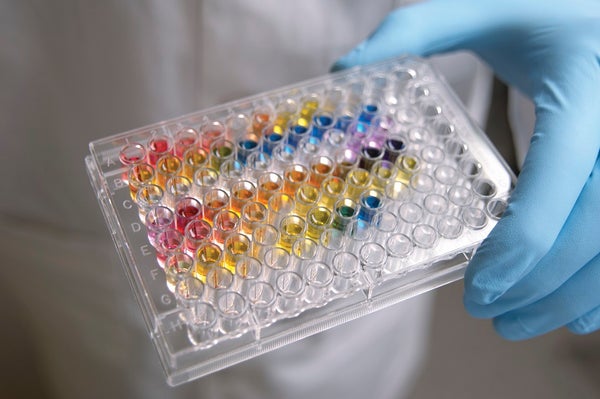

Chemists come up with new substances every year to go in everything from makeup to medicines. But introducing these chemicals into products also raises questions about their potential dangers. Can they irritate the skin? The eyes? Could they damage DNA?
To identify these possible risks, companies often test chemicals on animals. But these trials are expensive and time-consuming, and the results aren’t always reliable. Plus, many consumers are uncomfortable with their favorite products being tested on animals—like mice, rabbits, and guinea pigs.
But we may be able to avoid animal tests without sacrificing the ability to forecast problems. Because researchers have developed a computer program that can predict the toxic effects of new chemicals better than animal testing can.
On supporting science journalism
If you're enjoying this article, consider supporting our award-winning journalism by subscribing. By purchasing a subscription you are helping to ensure the future of impactful stories about the discoveries and ideas shaping our world today.
The method relies on a database that the scientists created that includes the results of more than 800,000 animal tests documented in various toxicology registries, covering about 10,000 chemicals.
Such databases make it possible for an expert to anticipate the dangers of an untested chemical by comparing it to similar chemicals. This process is called “read-across,” and it is the main alternative to animal testing. But read-across is subjective. Different people might choose different comparison chemicals based on what compounds they’re familiar with. They could even come to opposing conclusions.
So, to remove that subjectivity, the researchers programmed a computer to do read-across on their database for them. Their method uses machine learning algorithms to compare the structures and toxic effects of different chemicals. The result is a sort of map of chemical structures and properties that allows them to predict the potential toxic effects of a new chemical based on where it sits on that map.
And this method enabled the scientists to predict a chemical’s dangers more accurately than did some of the most commonly used animal tests. Their results are detailed in the journal Toxicological Sciences. [Thomas Luechtefeld et al., Machine Learning of Toxicological Big Data Enables Read-Across Structure Activity Relationships (RASAR) Outperforming Animal Test Reproducibility]
The software is being made commercially available by Underwriter’s Laboratories, which co-sponsored the research. Given that computer programs don’t need the money or time to run that animal experiments do, this virtual toxicology screening should appeal to companies and animal lovers alike.
—Deboki Chakravarti
[The above text is a transcript of this podcast.]

