
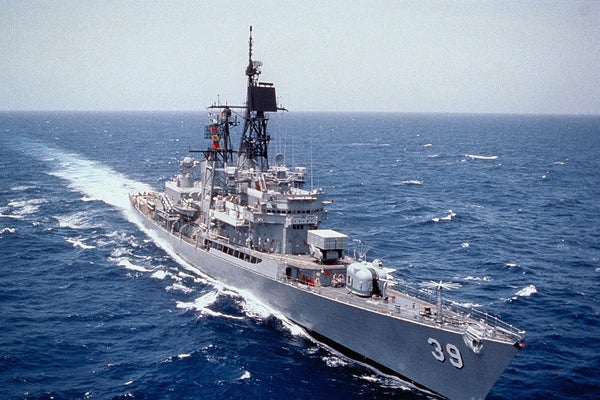

In The Hunt for Red October, the Soviet submarine captain played by Sean Connery commands his crew to verify the location of a target. <
That ping is known as "active sonar." Bob Headrick of the Office of Naval Research, the ONR, says it's the audio equivalent of switching on a flashlight. You're getting information, but also broadcasting your location to other ships.
"And you know the number one priority in the submarine is to remain undetected." Subs can keep their secrecy by eavesdropping on other ships instead… listening for propellers and electronics and so on. Such methods, known as "passive sonar,” generally require a skilled operator. But researchers are teaching machines to do it, too.
On supporting science journalism
If you're enjoying this article, consider supporting our award-winning journalism by subscribing. By purchasing a subscription you are helping to ensure the future of impactful stories about the discoveries and ideas shaping our world today.
They first recorded the underwater rumblings of cargo ships off the California coast <
"And it did extremely well." Emma Ozanich, a PhD Student in underwater acoustics at the Scripps Institution of Oceanography. Using the audio data, she says the algorithms pinpointed the ships to within a couple hundred meters, at distances of up to 10 kilometers.
But it's not so clear what the machines now know. "One of the interesting parts about machine learning, especially neural networks, is that it's more difficult to pull out what it's actually learning specifically. It's a little bit of a black box." The research is in The Journal of the Acoustical Society of America. [Haiqiang Niu et al., Ship localization in Santa Barbara Channel using machine learning classifiers]
Bob Headrick of ONR says the data set used here is relatively simple, compared to the real-world scenarios subs would have to solve. Still, he says, with lots more development: "You could conceive with enough effort you create the computer program that can beat the trained operator."
There is a precedent, after all, for machines defeating our best human operators. It was in that other great battle of the cold war: the game of chess.
—Christopher Intagliata
[The above text is a transcript of this podcast.]
