
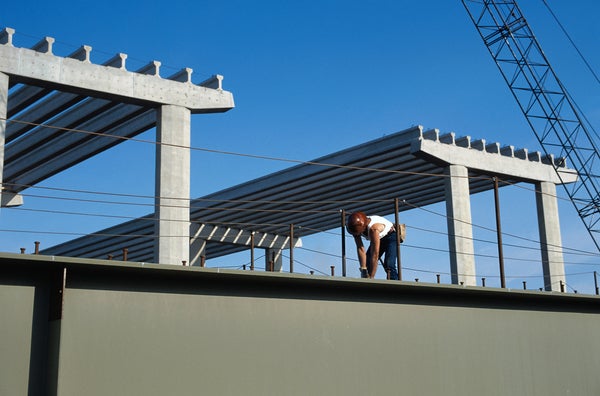

Concrete is one of the most widely used materials on the planet. "And this consumption comes with a heavy ecological price." Rouzbeh Shahsavari, a materials scientist at Rice University. "Around 5 to 10 percent of total CO2 emissions comes from concrete production."
One way to reduce those emissions, he says, would be to increase the strength and toughness of concrete. So you need less of it in construction. But to make something stronger, you need to understand its weaknesses.
So Shahsavari and his team studied the defects in a rock called tobermorite. (TO-ber-MOR-ite) The rock is an analog for wet cement, the main ingredient in concrete. And they found that certain defects in the rock actually made the rock tougher, if they were aligned in a specific configuration. Sounds counterintuitive: Defects a good thing?
On supporting science journalism
If you're enjoying this article, consider supporting our award-winning journalism by subscribing. By purchasing a subscription you are helping to ensure the future of impactful stories about the discoveries and ideas shaping our world today.
"Defects are typically considered a bad feature of material. But when it comes to complex systems, like cement or concrete, it's not the case. It may actually be an opportunity to introduce toughness, or get something better out of it." The study is in the journal ACS Applied Materials and Interfaces. [Ning Zhang, Philippe Carrez, and Rouzbeh Shahsavari, Screw Dislocation-Induced Strengthening-Toughening Mechanisms in Complex, Layered Materials: The Case Study of Tobermorite]
Next step, Shahsavari says, would be to optimize concrete recipes—to use these defects in their favor. Play with manufacturing temperatures, or alter the ratios of impurities in the mix. "Since we're using it pretty much in every building, every bridge, every highway in all parts of the world, even a slight impact in the performance could have a huge consequence in terms of energy consumption, CO2 footprint, and all those things." And take a little concrete out of the concrete jungle.
—Christopher Intagliata
[The above text is a transcript of this podcast.]
