
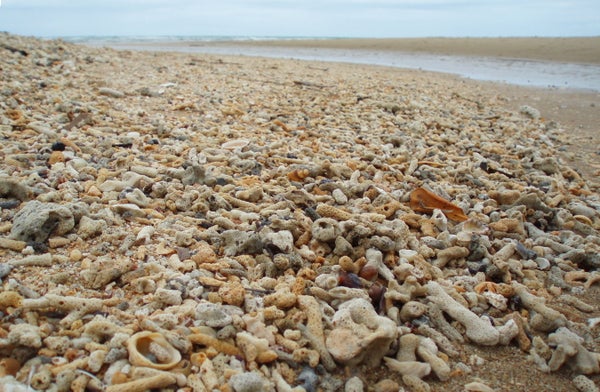

A marine heatwave in 2016 killed off a full third of Australia's Great Barrier Reef, the largest coral reef system in the world.
"It's terrible watching your favorite ecosystems slowly die."
Carly Kenkel is a marine biologist at the University of Southern California who studied that coral bleaching event. Bleaching occurs when the waters around corals become too cold, or too salty, or too hot—but mostly, too hot. And then, the symbiotic algae that live inside corals—which are photosynthetic food factories—abandon the corals. Which causes the corals to die.
On supporting science journalism
If you're enjoying this article, consider supporting our award-winning journalism by subscribing. By purchasing a subscription you are helping to ensure the future of impactful stories about the discoveries and ideas shaping our world today.
"Because they're losing their nutritional source, so they're essentially starving to death."
But coral can house multiple species of algae—some more heat tolerant than others. So sometimes, in the face of stress, the hardier algae proliferate. That change offsets the damage caused by the exodus of the more sensitive species… a process called "shuffling."
Kenkel and her colleagues studied shuffling in corals affected by the 2016 bleaching event, on the Great Barrier Reef. And they found that adult corals can actually pass those reshuffled algal residents along to their offspring, in their eggs—pointing to a possible way successive generations of coral could adapt to warmer waters.
"If your mom can kind of prime you for the environment that you might be experiencing, that presumably would improve your fitness." The details are in the journal Scientific Reports. [Kate M. Quigley, Bette L. Willis & Carly D. Kenkel, Transgenerational inheritance of shuffled symbiont communities in the coral Montipora digitata]
So can this help corals beat back bleaching? "The pace of climate change and the frequency and intensity of these stress events is such that I don't think this is enough."
So in the face of so many threats, even this trick may fail to provide relief for the reef.
—Christopher Intagliata
[The above text is a transcript of this podcast.]
