
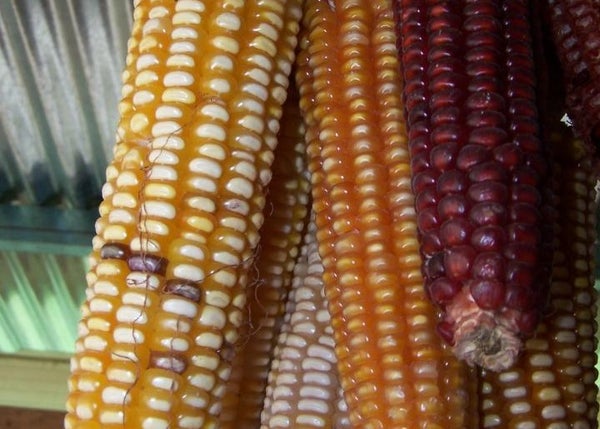

Plants need three things to grow: air, water and nutrients. Farmers usually take care of the last bit by fertilizing their fields. But now scientists have found a type of corn that seems to thrive on air and water alone.
"This has been sort of the holy grail, you know, if only I could grow corn and not put 200 pounds of nitrogen on it." Allen Van Deynze is a plant breeder at the University of California, Davis, and part of a team that analyzed this one corn’s unusual ability.
The corn variety hails from Oaxaca, Mexico, where it typically grows in nitrogen-poor soils. Nitrogen is needed for proteins, DNA and the chlorophyll that let plants perform photosynthesis. But the Oaxacan corn does well despite the bad soil, and with little or no fertilization.
On supporting science journalism
If you're enjoying this article, consider supporting our award-winning journalism by subscribing. By purchasing a subscription you are helping to ensure the future of impactful stories about the discoveries and ideas shaping our world today.
The plants pull off this trick via thick, red, aerial roots that protrude from its stem—above the ground—that ooze out a clear goo packed with sugars. That slime is the perfect habitat for nitrogen-fixing bacteria: a sugar-rich, oxygen-poor environment where the microbes transform nitrogen gas into a soluble form the corn plant can use. It’s an aboveground version of the nitrogen-fixation you might usually think of as happening in the underground roots of legumes, like peas and beans.
The researchers demonstrated the corn plants’ talent by exposing them to labeled isotopes of nitrogen. And they were able to track the movement of the distinctly identifiable nitrogen atoms from the air, to the root and into the plant. This pathway allows the corn to obtain up to 80 percent of its nitrogen straight out of the air. The details are in the journal PLOS Biology. [Allen Van Deynze et al., Nitrogen fixation in a landrace of maize is supported by a mucilage-associated diazotrophic microbiota]
Van Deynze says early plant breeders may have inadvertently got rid of corn’s nitrogen-fixing proficiency long ago. "When early man made some selections for bigger ears, higher yield, perhaps they lost this ability along the way. And we have the opportunity perhaps to bring it back."
—Christopher Intagliata
[The above text is a transcript of this podcast.]
