

Four billion years ago, our solar system was a very different… very violent place. "This is the time when life was just emerging on our planet." Stephen Mojzsis, a geologist at the University of Colorado, Boulder. "It's the time when most of the big scars of the craters of the moon formed."
Those scars are the remnants of what he calls a game of planetary billiards. And Jupiter's gravity is the big break, which sends comets and asteroids flying. "And then these things go bouncing around all over the place. Many of the directions that they go are unpredictable even if they are governed by gravity."
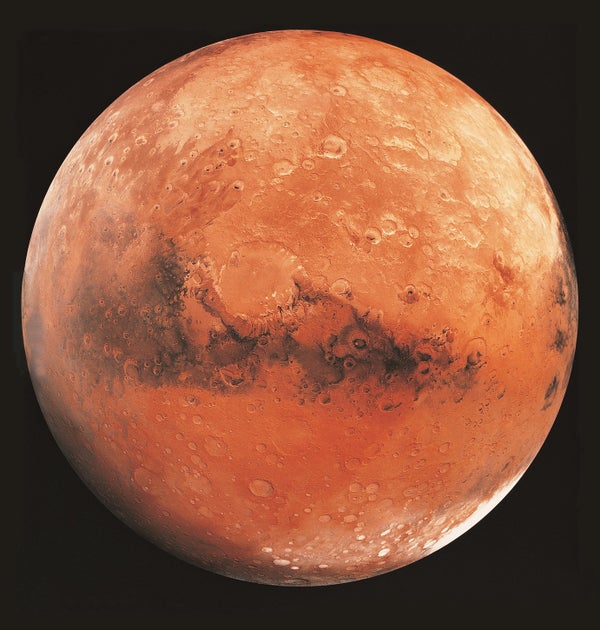
Mojzsis and his colleague Oleg Abramov used supercomputers to model the beat-up surface of Mars at that long-ago time. And they found that all that planetary pummeling—from tiny sand grains on up to a rocks at least 25 times as big as the one that killed off the dinos here on Earth—could have translated into enough thermal energy to cook the surface of the planet, melt the Martian ice and start up hydrothermal springs.
On supporting science journalism
If you're enjoying this article, consider supporting our award-winning journalism by subscribing. By purchasing a subscription you are helping to ensure the future of impactful stories about the discoveries and ideas shaping our world today.
"And for microbial life, hydrothermal systems, also known as hot springs, it's like the free buffet bar in Vegas—everyone just rushes there. It's just lots and lots and lots of food for microbial life. And they flourish." The study is in the journal Earth and Planetary Science Letters. [Oleg Abramov, Stephen J. Mojzsis: Thermal effects of impact bombardments on Noachian Mars]
Mojzsis has this advice for anyone hunting for alien life on Mars: stick to crater bottoms, "an area that had heat for a long time, that could drive hydrothermal activity. I do not know if life originated in such places, but I can tell you now, wherever there's a hot spring environment it's just completely jam-packed with microbes. So that's where I would look." And that happens to be where NASA's Curiosity rover is looking right now.
—Christopher Intagliata
[The above text is a transcript of this podcast. Sound effect courtesy of cameronsound.]
