
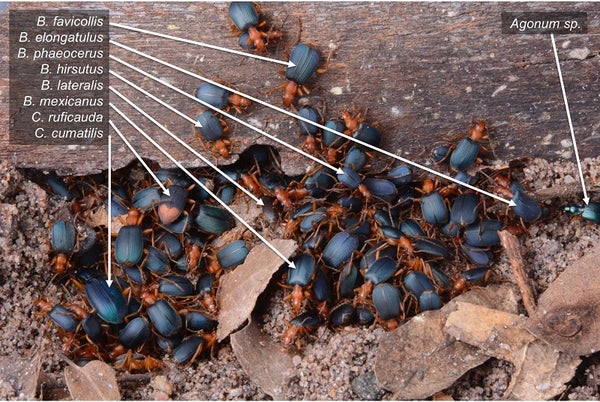

If you’re a skunk, or fox, or very strange person, and you poke your nose under a rock in the desert Southwest, looking for something to eat, you might be surprised to see dozens of bright blue and red beetles scurrying to and fro. And you might be really curious as they quickly turn their butts toward you.
But the curiosity wouldn’t last long: a couple thousandths of a second later, a fusillade of boiling hot, toxic spray would drive off both you and your musings.
The insects with the spraying butts are fittingly named bombardier beetles. And they can fire off 500 pulses per second of caustic defensive chemicals. What also makes them unusual is that even though the nocturnal beetles are solitary by night, dozens or even hundreds of them—of various bombardier species—snuggle together under rocks during the day.
On supporting science journalism
If you're enjoying this article, consider supporting our award-winning journalism by subscribing. By purchasing a subscription you are helping to ensure the future of impactful stories about the discoveries and ideas shaping our world today.
“It's actually a fairly unusual phenomenon for different species to regularly associate with one another.”
University of Arizona entomologist Wendy Moore.
“But these guys are sheltering together, and they're actually doing it intentionally, you know, because they have more options. There’s plenty of options within the habitat that they could actually segregate out by species, and they don’t.”
In fact, when Moore and her colleagues put beetles into a setting where they had cozy solitary hiding places, as well as hiding places already packed with other beetles, the newcomers invariably chose to shelter with others under the crowded rocks. The study is in the journal PLOS One. [Jason C. Schaller et al., Molecular phylogeny, ecology and multispecies aggregation behaviour of bombardier beetles in Arizona]
Moore says buddying up may help protect the insects from predators.
“Bombardier beetles produce benzoquinones, which are really powerful as a matter of defense, but these other beetles produce other kinds of defensive chemicals that probably contribute to a big chemical cocktail for a vertebrate predator that might find them during the day.”
In addition, a lone beetle, no matter how brightly colored, might not scare off a predator as effectively as a whole bunch of beetles.
“If you imagine being a predator, even a human, turning over a rock and seeing hundreds of these blue and red beetles going in every direction, that serves as a bigger advertisement to them of their toxicity. It may help them be able to avoid attack.”
So whatever you can say about an encounter with these fearsome little insects, you can’t say that you weren’t warned.
—Bob Hirshon
[The above text is a transcript of this podcast.]
