
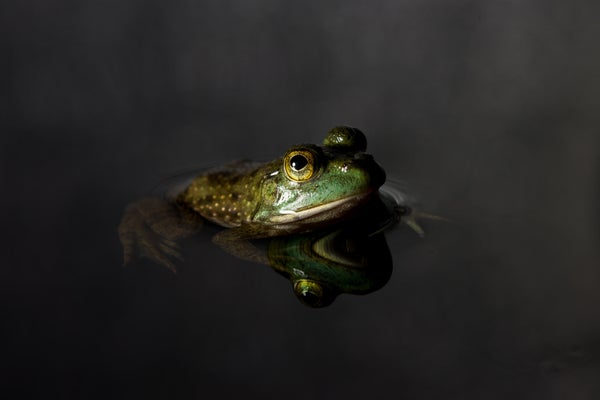

The animal kingdom is a noisy place. There’s bird song ...
[CLIP: Bird whistle]
... choruses of frogs ...
On supporting science journalism
If you're enjoying this article, consider supporting our award-winning journalism by subscribing. By purchasing a subscription you are helping to ensure the future of impactful stories about the discoveries and ideas shaping our world today.
[CLIP: Frog chorus]
... and lots of lesser known sounds, like the ray gun–like sounds of baby alligators hatching and calling for Mom.
[CLIP: Baby alligator sound]
There’s lots of videos of them doing this on YouTube if you’re curious.
“When I was a kid growing up, I had a pet alligator. It vocalized a lot.”
John Wiens, an evolutionary ecologist at the University of Arizona.
“So I had this baby alligator when I was a teenager. Sometimes I could hear ‘Urh urh urh urh.’ And when they grow up, they make bellows and slaps and all sorts of sounds.”
Wiens and his collaborator Zhuo Chen wondered: Why did animals start vocalizing in the first place? One hypothesis was that the ability originated in nocturnal animals—cause, you know, sound works a lot better than colors or horns or other visual cues when you can’t see.
Wiens and Chen built an evolutionary tree of nearly 1,800 vertebrate species and mapped onto it information on whether each lived by day or night and whether they made sound.
“So one of the things we did then was to do a statistical correlation between the evolution of acoustic communication and whether they were active by day or by night. And we found a very strong relationship. Those that are active at night tend to evolve acoustic communication.”
Suggesting that the nocturnal notion was more than just a shot in the dark.
The findings are in the journal Nature Communications. [Zhuo Chen and John J. Wiens, The origins of acoustic communication in vertebrates]
This ability to vocalize likely arose independently, multiple times, hundreds of millions of years ago—in frogs, mammals, geckos, and birds and crocodilians. And though vocalization might have originated with nocturnal animals, some night dwellers seem to have lost the ability—like pangolins—while others, which evolved to be active by day, retained it—like, of course, you and me.
—Christopher Intagliata
[The above text is a transcript of this podcast.]
Credit: InspectorJ Freesound.org (bird whistle sound and frog chorus sound)
