
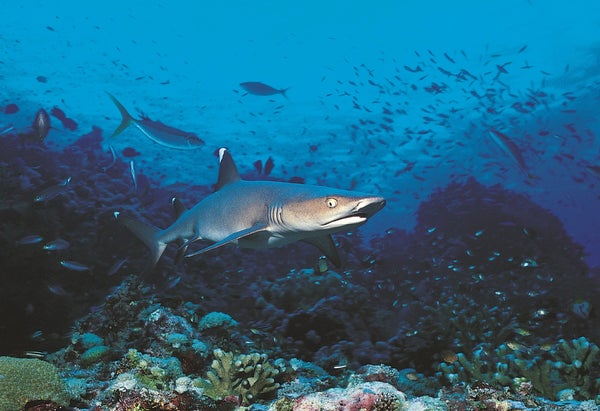

The way we sample much of the world's oceans, to see what's living down there, is pretty basic: Ask fishermen. Or just stick a net down there, and examine what we catch. Neither method is ideal. "Because you basically catch the fish and kill them." Philip Francis Thomsen, a biologist at the Natural History Museum of Denmark. Another drawback, he says, is you can't do it everywhere. "If the bottom is too soft, or too rocky, or there's a coral reef, you don't want to use this invasive method above sensitive habitat."
So Thomsen and his team investigated an alternative, that's been used in freshwater with some success: they sampled the diversity and abundance of marine life using something called environmental DNA, or "eDNA." Basically, genetic material that fish leave behind. "So that is all sorts of bodily fluids that are expelled by the fish during its lifetime." And beyond its lifetime too—like when one fish gets eaten, and its remains get expelled in the fecal matter of another. Bingo: eDNA.
Thomsen and his colleagues sampled seawater at various depths off the southwest coast of Greenland. And then fished out the eDNA in those samples. The researchers were able to identify 26 of the 28 fish families caught in the same area in trawling nets—and at similar abundances, too. They also found a few unique families missed by the nets, and lots of DNA from a species that, in net samples, seemed rare: the Greenland shark.
On supporting science journalism
If you're enjoying this article, consider supporting our award-winning journalism by subscribing. By purchasing a subscription you are helping to ensure the future of impactful stories about the discoveries and ideas shaping our world today.
"We found the shark in almost all of the samples. That is because the shark just avoids the trawl. So here's an example of a species that is actually better surveyed by the environmental DNA than the trawling." The study is in the journal PLoS ONE. [Philip Francis Thomsen et al., Environmental DNA from Seawater Samples Correlate with Trawl Catches of Subarctic, Deepwater Fishes]
The technique's not quite ready for primetime in the marine setting: for one, ocean currents could transport a species' DNA far from where the fish may actually be found, and give inaccurate measures. But in the future, it might take the fishing out of fish surveys.
—Christopher Intagliata
[The above text is a transcript of this podcast.]
