
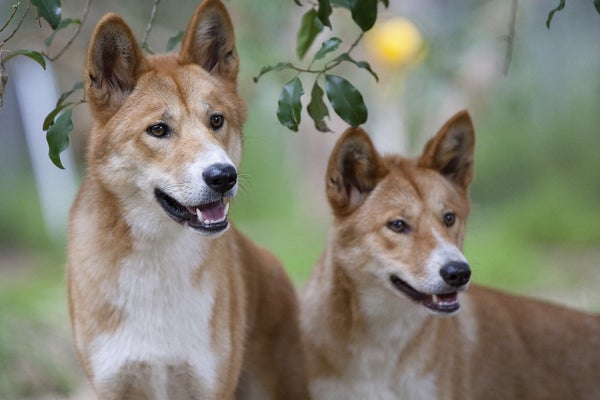

If you need help herding some sheep or retrieving a stick, you can count on your canine companion. Because dogs always seem to be keen on lending a paw. But only if their partner is a person. When it comes to cooperating with one another, dogs are truly lost…and instead it’s wolves who’ve mastered the art of teamwork. That’s according to a study in the Proceedings of the National Academy of Sciences. [Sarah Marshall-Pescini et al., Importance of a species’ socioecology: Wolves outperform dogs in a conspecific cooperation task]
For thousands of years, humans have been breeding dogs that can do all sorts of neat tricks. And because pups aim to please, we’ve come to think that domestication has somehow boosted dogs’ powers of cooperation. But researchers in Austria have been wondering whether that notion could be barking up the wrong tree. Because left to their own devices, dogs are bigger loners than wolves.
“So wolves live in closely knit family packs, they cooperate in raising the young, they also cooperate in hunting and in defending their territories. So they really have a strong dependence on cooperation in many aspects of their lives. In contrast, to this free ranging dogs actually forage mostly by themselves solitarily. It’s only mothers that raise their young. And they do form packs but they tend to be somewhat more fluid, if you want.”
On supporting science journalism
If you're enjoying this article, consider supporting our award-winning journalism by subscribing. By purchasing a subscription you are helping to ensure the future of impactful stories about the discoveries and ideas shaping our world today.
That’s Sarah Marshall-Pescini of the Wolf Science Center at the University of Vienna. She and her colleagues decided to test dogs’ and wolves’ relative powers of cooperation. In the setup, a pair of animals…either two dogs or two wolves…is presented with a contraption that will allow the participants to access a tray of food…but only if both members of the team simultaneously pull on the two ends of a rope.
A dozen wolves and 14 dogs took the challenge. And the results? The wolves ran circles around their doggie descendants. In some 400 attempts, the wolf teams scored a snack 100 times. Which may not sound all that impressive…until you compare it with the doggie duos, who, in nearly 500 trials, succeeded only twice.
Now, it’s not that dogs are less avid learners. Or that they turned tail and avoided the apparatus. Marshall-Pescini says the pooches were curious about the device.
“What seemed to be happening was they didn’t want to get into conflict with each other. So they wouldn’t both go and try things on it but rather took it in turns. And this really hindered their capacity to cooperate.”
So rather than step on each others’ toes, the hounds took turns bowing out, giving their teammate a chance at the plate. That show of social grace left the poor pups with their tummies growling. And no treat to wolf down.
—Karen Hopkin
[The above text is a transcript of this podcast.]
