
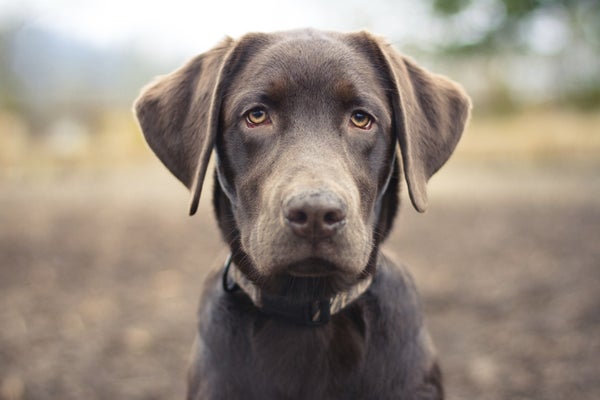

Old Yeller was a great smeller. Dogs in general have superior smelling abilities. They detect dead bodies, illegal drugs and explosives—even cancer. But dogs don't just have great olfactory gear. Another reason they're amazing chemical detectors? [sniffing sound] … is the sniff.
"And it turns out almost every breed of dog does this at 5 Hz. Five times a second." Matthew Staymates, a mechanical engineer and fluid dynamicist at the National Institute of Standards and Technology. Sniffing, he says, is really a two-part process. “Inspiration, expiration, right? Inhale, exhale, inhale, exhale." That second part, the exhale, is key.
"So when the dog is actively sampling or sniffing on the ground, there is a turbulent air jet that exits each nostril during the exhale phase. Just like when you and I exhale there's an air jet that comes out of our nostrils. But the dog is down on the ground and those air jets are vectored down and toward its rear. And in the world of fluid dynamics, if I pulse an air jet in one direction I basically pull air with it." So the dog is creating a pressure differential that effectively pulls new scents toward its nose.
On supporting science journalism
If you're enjoying this article, consider supporting our award-winning journalism by subscribing. By purchasing a subscription you are helping to ensure the future of impactful stories about the discoveries and ideas shaping our world today.
Staymates and his colleagues discovered that effect using a 3-D–printed model of a Labrador retriever's nose, which they tested with fluid dynamics equipment. They then outfitted a commercial vapor detector with sniffing nostrils, inspired by the dog nose. And they found that the actively sniffing detector was 16 times better at picking up the scent of explosives, compared to just continuously drawing in air—the usual method. The results are in the journal Scientific Reports. [Matthew E. Staymates et al., Biomimetic Sniffing Improves the Detection Performance of a 3-D Printed Nose of a Dog and a Commercial Trace Vapor Detector]
Staymates says he hopes next-generation sensors take sniffing seriously. "There's nanosensors out there that can detect very, very small amounts of materials. One of the things that's been overlooked: is how do you get the molecules of interest to the detector? So you can have the most sophisticated detector in the world, but unless you can get material to it, it's not very useful." Adding a sniffer though…could be just the thing to make those detectors more dogged.
—Christopher Intagliata
[The above text is a transcript of this podcast.]
