
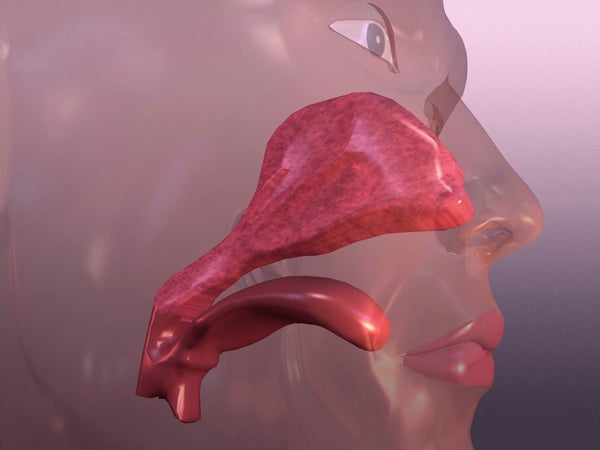

Ever lose your ability to taste during a cold, because your nose is stuffed up? That’s because the nose is intimately involved with taste. When you chew, volatile flavor compounds from the food get lofted toward the back of your mouth. And when you exhale you carry some of those flavor compounds up into your nasal cavity, where they hit olfactory receptors.
"As children we basically learn, the first lesson of table manners is to keep the mouth closed while chewing, and you also want to breathe smoothly." Rui Ni, a mechanical engineer at Penn State. "I think not only because it's courteous, but you can also smell the food much better if you breathe smoothly."
The backdoor by which smell contributes to taste is called "retronasal olfaction." And it turns out our airways are exquisitely tuned to enhance that effect.
On supporting science journalism
If you're enjoying this article, consider supporting our award-winning journalism by subscribing. By purchasing a subscription you are helping to ensure the future of impactful stories about the discoveries and ideas shaping our world today.
Ni and his colleagues 3D-printed a model of a woman's airway, using a CT scan as a template. To track airflow, they laced water with fluorescent particles and pumped it through the apparatus, filming the results. They found that when you breathe in, that inward airflow actually forms a curtain at the back of your mouth, blocking food particles from getting into the lungs--a good thing. And when you exhale, air swirls through that cavity in the back of the mouth, sweeping up those volatile particles and delivering them right to the nasal cavity, where you can smell them. The results appear in the Proceedings of the National Academy of Sciences. [Rui Ni (倪睿) et al, Optimal directional volatile transport in retronasal olfaction]
There is a way to derail this well-tuned system: the effect's ruined if you're really huffing and puffing. Meaning if you're wolfing down your food, gasping for air, that turbulent breathing actually delivers more of those food molecules into your lungs and less up into the nasal cavity. In other words, your mother was right all along: keep your mouth shut and don’t bolt your food. It’ll cut the chances of choking, and enhance the taste of the meal.
—Christopher Intagliata
[The above text is a transcript of this podcast.]
