
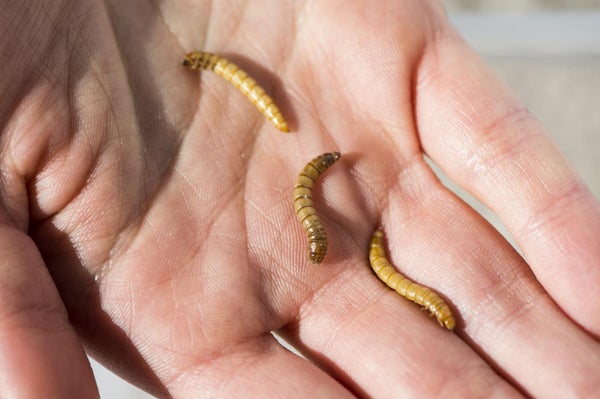

A pound of chicken will set you back a couple bucks. Ground beef, maybe three to four dollars a pound. But a pound of protein-rich dried mealworms could cost twice as much.
"The price per pound of mealworms is still relatively expensive." Juan A. Morales-Ramos is a research entomologist with the USDA in Stoneville, Mississippi. But he says that cost might be coming down.
For eight years, he and his team have selectively bred mealworms, which are the larvae of a type of darkling beetle. Their goal was to breed larger and larger worms - and they succeeded in nearly doubling the size of the larvae. But doubling up came with an evolutionary tradeoff: larger larvae had fewer eggs, and their offspring weren't as hardy as the ancestral strain.
On supporting science journalism
If you're enjoying this article, consider supporting our award-winning journalism by subscribing. By purchasing a subscription you are helping to ensure the future of impactful stories about the discoveries and ideas shaping our world today.
Still, generations are shorter in the worm world—meaning it's faster to experiment—and sequencing the genes of the selected strains might reveal new traits to breed for.
"We may be able to produce a superline of mealworms that grow faster and larger and probably produce more eggs, hopefully." The findings are in The Journal of Insect Science. [Juan A Morales-Ramos et al., Body Mass Increase Induced by Eight Years of Artificial Selection in the Yellow Mealworm (Coleoptera: Tenebrionidae) and Life History Trade-offs]
The eventual goal is to bring mealworms beyond fishing bait. If the cost comes down, they'd be an economical protein source for farmed fish and chicken feeds. And one recent study rated them as significantly healthier than beef or chicken—for a human diet. Other cultures are leading the way.
"There are many cultures not just in Mexico but in Asia and Africa that regularly consume different types of insects. They sell them in the market. In Mexico there are restaurants that specialize in serving insects. And I'm not talking just regular restaurants, these are like five star restaurants doing that."
Of course, here in the US we also eat insects. But in the near future we might do it on purpose.
—Christopher Intagliata
[The above text is a transcript of this podcast.]
