

The flat lithium ion batteries that power smartwatches are built by stacking the battery components: positive and negative electrodes, current collectors and a separator. It's akin to piling up sheets of paper—you get a stack that you can bend or roll—but you can't stretch it.
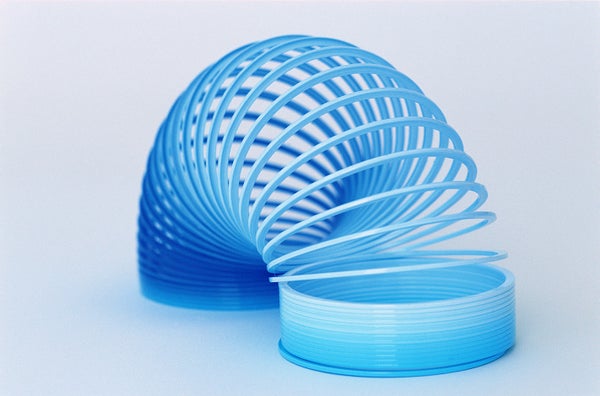
But now researchers have designed what could be a much friendlier battery for wearables. One that's bendy and stretchy, instead of a little brick. They built the bendy battery by starting with a coiled wire, sort of like a slinky—then layered the traditional battery components—electrodes, and all that—on the coil, to build a silver–zinc based battery. And the result?
"Once the battery is flexed it experiences very minimum stresses. You can imagine flexing the slinky, you can easily flex it." Alla Zamarayeva, a materials scientist at U.C. Berkeley. "That's why we were able to flex this battery for 17,000 times while there was cycle in it, in situ, without decreasing electrochemical performance."
On supporting science journalism
If you're enjoying this article, consider supporting our award-winning journalism by subscribing. By purchasing a subscription you are helping to ensure the future of impactful stories about the discoveries and ideas shaping our world today.
She and her team built even stretchier batteries using serpentine designs—imagine squiggly lines of battery, embedded in a transparent polymer that looks like a band-aid. When you pull the ends of the Band-Aid, the squiggle elongates—offering stretchiness at larger scales. The study is in the journal Science Advances. [Alla M. Zamarayeva et al., Flexible and stretchable power sources for wearable electronics]
Zamarayeva's co-author Aminy Ostfeld helped integrate the bendy battery into an energy-storage bracelet. And it has a feature you won't yet find on the Apple Watch: solar cells. "Especially as more and more of these kinds of devices are being developed and we have more and more of them per person, it's going to start getting pretty impractical for us to plug in every single one of them." If their ideas are commercialized, they could give wearables designers a lot more flexibility to innovate.
—Christopher Intagliata
[The above text is a transcript of this podcast.]
