

New Zealand once had a Dr. Seuss–worthy assortment of birds—take the giant moa, a flightless bird twice as tall as an adult human, which weighed more than a sumo wrestler. Then there was the Haast’s eagle, the largest eagle ever known to exist. It hunted the moa.
But, as the story often goes, then came humans: first the Maori, about 700 years ago, and then European colonists, a couple hundred years ago. Both sets of people drove many of New Zealand’s unique birds to extinction. And many of the surviving species are now threatened or endangered.
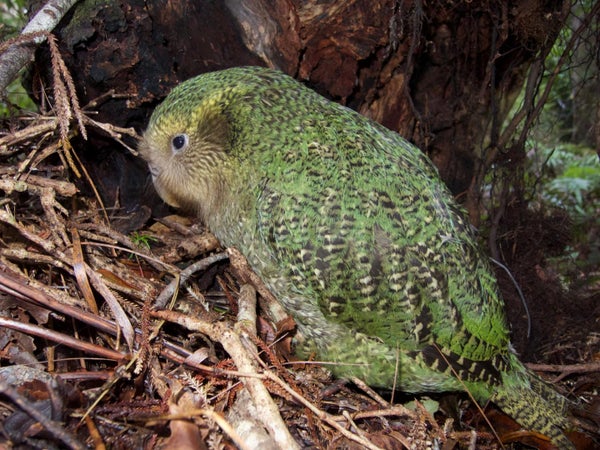
“So you have species like the kiwi, the kakapo, kea, the kaka, the takahe—all with nice Maori names, but all in danger of going extinct.”
On supporting science journalism
If you're enjoying this article, consider supporting our award-winning journalism by subscribing. By purchasing a subscription you are helping to ensure the future of impactful stories about the discoveries and ideas shaping our world today.
Luis Valente, an evolutionary biologist at the Natural History Museum of Berlin. Valente and his colleagues used genetic data to build a tree of New Zealand’s living and extinct native birds. They then used a model to estimate how long it took new species to emerge. Which allowed them to assess humans’ bird-killing habits—on an evolutionary time scale.
“In a couple of centuries, humans wiped out 50 million years of evolutionary history. So the little impact we think we have is having repercussions for millions of years.” The analysis is in the journal Current Biology. [Luis Valente, Rampal S. Etienne and Juan C. Garcia-R., Deep macroevolutionary impact of humans on New Zealand’s unique avifauna]
Looking ahead, the scientists say it could take another 10 million years to recover species that are currently threatened, or near threatened, if nothing is done to save them. But it’s not all doom and gloom.
“The conservation efforts being done in New Zealand at the moment are quite pioneering, and they’ve been quite successful. So I think we’re still at a position where we can still prevent lots of millions of years of evolution from further being lost.” As ecologist Aldo Leopold said, “To keep every cog and wheel is the first precaution of intelligent tinkering.”
—Christopher Intagliata
[The above text is a transcript of this podcast.]
