
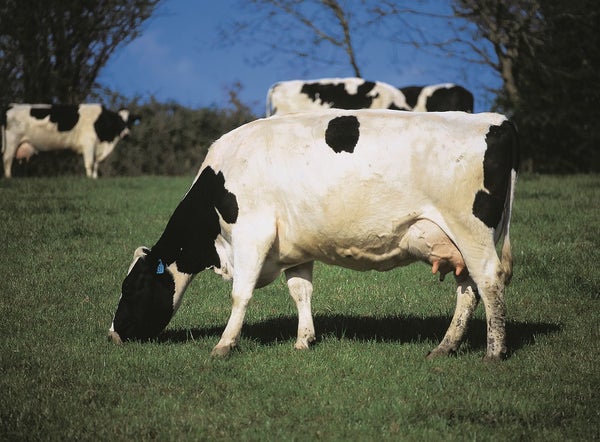

The global population is now nearly seven and a half billion. And that’s just humans. Because our planet is also home to one-and-a-half-billion cows, another billion sheep, and a billion goats. Their combined belches account for a full fifth of the world's methane emissions—and methane is about 30 times more potent at trapping heat than CO2.
But those methane emissions might get cut—by feeding the grazers something called 3-nitrooxypropanol. "I can tell you, they like it. No rejection at all." Maik Kindermann, an organic chemist at DSM Nutritional Products in Switzerland. Liking it, in the cow world, he says basically means they'll still gobble up their food, even with this stuff mixed in.
Kindermann's company developed the additive a few years back. It jams up an enzyme crucial to the production of methane by microbes that live inside the animals. And it only targets those methane-belching microbes, while leaving the rest of the microbiome untouched. The result? A 30 percent decrease in methane emissions. The study is in the Proceedings of the National Academy of Sciences. [Evert C. Duin et al: Mode of action uncovered for the specific reduction of methane emissions from ruminants by the small molecule 3-nitrooxypropanol]
On supporting science journalism
If you're enjoying this article, consider supporting our award-winning journalism by subscribing. By purchasing a subscription you are helping to ensure the future of impactful stories about the discoveries and ideas shaping our world today.
Kindermann says he thinks the compound could be a win-win for the planet—and the animals. "You know the methane is kind of a waste product. And this energy, instead of losing it for the animal, it can be reused for the animal in terms of performance, and at the same time we are doing something for greenhouse gas emission and climate change." The product’s not on the market yet—toxicology tests are ongoing. But the hope is that it might take some of the heat off of beef.
—Christopher Intagliata
[The above text is a transcript of this podcast.]
Editor's note: some language in this podcast has been revised for clarity.
