
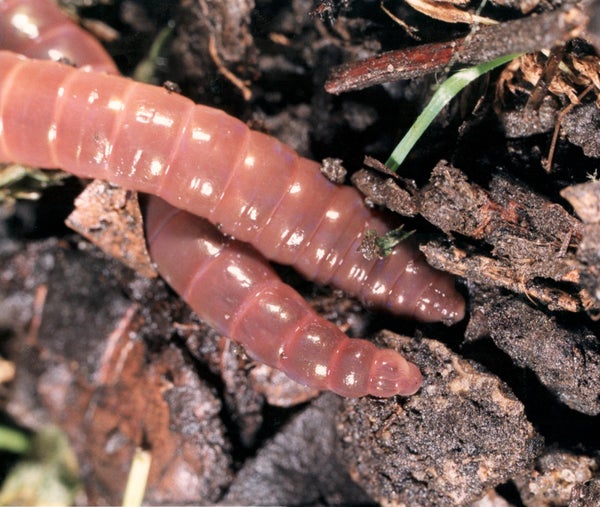

Charles Darwin is, most famously, the author of The Origin of Species. But the last book he ever wrote gets far less attention today. It's called The Formation of Vegetable Mould through the Action of Worms. And earthworms were a passion: he wrote about their habits, their soil-tilling abilities, and even kept pots of worm-filled soil in his study.
But his fascination was met with ridicule by some. "There's a famous cartoon where Darwin as an old man is in the middle. He evolves from monkeys and the monkeys evolved from earthworms."
Olaf Schmidt is a soil ecologist at University College Dublin. And not among those who would criticize Darwin for his interests. "I love earthworms, earthworms are brilliant. They're our friends, they're really important."
On supporting science journalism
If you're enjoying this article, consider supporting our award-winning journalism by subscribing. By purchasing a subscription you are helping to ensure the future of impactful stories about the discoveries and ideas shaping our world today.
One particularly interesting group of worms, he says, are the so-called "anecic" worms: the deep soil dwellers. "They live all their life in a single vertical channel in the soil. And at night they surface," looking for food—manure, straw, stuff like that, "and they pull it into their channels."
They're big boys. Which makes them especially vulnerable to the plow. "Because they're so big, so they're chopped, exposed to birds, and their channels are destroyed."
Schmidt and his colleague Maria Briones analyzed the relationship between tilling and the health of a dozen species of earthworms. They looked at 65 years'-worth of farm field studies, spanning the globe.
And they found that in heavily plowed fields, half the earthworms had disappeared. But when farmers switched to no-till or conservation agriculture, worm populations wriggled back to normal numbers after about a decade. The study is in the journal Global Change Biology. [Maria J. I. Briones, Olaf Schmidt, Conventional tillage decreases the abundance and biomass of earthworms and alters their community structure in a global meta-analysis]
"The plow," Darwin wrote, "is one of the most ancient and most valuable of man's inventions; but long before he existed the land was in fact regularly plowed, and still continues to be thus plowed by earthworms." And, Schmidt says, just as the worms look after the soil, the flip side's true, too. "If you look after the soil, you also look after the earthworms. So it is a good-news story."
—Christopher Intagliata
[The above text is a transcript of this podcast.]
