
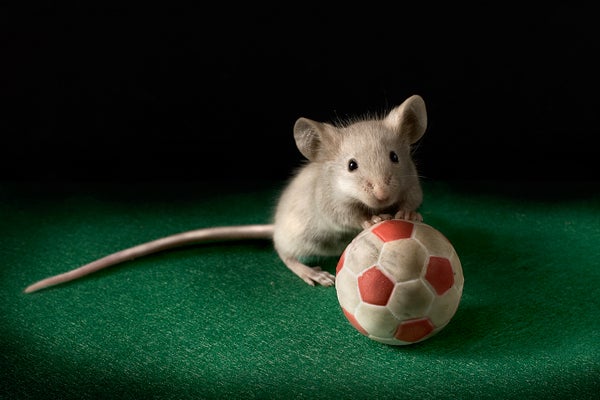

They say that Marie Antoinette’s hair turned white the night before she lost her head to the guillotine. But can stress really have such a dramatic effect on hair color? A new study in mice concludes that it can and credits overactive nerves with stripping the color from the animals’ locks—and possibly ours.
Researchers at Harvard’s Stem Cell Institute were interested in the stress and hair color issue. So they decided to take a closer look at those stem cells that give rise to melanocytes—the cells that pump pigments into each hair follicle. The stem cells were an obvious target ...
“Because changes in the stem cell population translate to changes in hair color, which are very visible and easy to identify.”
On supporting science journalism
If you're enjoying this article, consider supporting our award-winning journalism by subscribing. By purchasing a subscription you are helping to ensure the future of impactful stories about the discoveries and ideas shaping our world today.
Ya-Chieh Hsu, the study’s senior author.
To start, she and her colleagues subjected mice to some rodent-sized stressors—like having their cage tilted, their bedding dampened or their lights left on all night.
“So what did we find? We found that stress indeed leads to premature hair graying in mice. But it took a long time for us to actually narrow down how it occurs.”
First, they thought it could be the immune system attacking the melanocyte stem cell population.
“However, mice lacking immune cells still show premature hair graying under stress.”
Then they thought the key factor could be cortisol, the quintessential stress hormone.
“But when we removed the adrenal glands from the mice so they cannot produce cortisol-like hormones, their hair still turned gray under stress.”
That’s when they turned their attention to the sympathetic nervous system, which orchestrates the body’s overall reaction to stress, including the classic fight-or-flight response. Those nerves reach out to our muscles, organs and, yes, even our hair.
“The nerve terminals wrap around each hair follicle like a ribbon.”
And when Hsu and her team cut those connections, the stem cells were spared, and the animals kept their shiny black coat even in the face of minor discomfort. The findings appear in the journal Nature. [Bing Zhang et al., Hyperactivation of sympathetic nerves drives depletion of melanocyte stem cells]
It’s unclear whether the same sympathetic nerves make us gray as we age. But the results provide hope that we may someday be able to fight to hold onto our natural hair color—and avoid that monthly flight to the hairdresser.
—Karen Hopkin
[The above text is a transcript of this podcast.]
