

In the most recent podcast we discussed how baby bats learn their calls from all the other bats in their crowded colonies. And we mentioned in passing that songbirds usually get tutored directory from their dads. So, how does that avian system work?
"At about 25 days, the father starts singing directly to the juvenile." David Mets, a geneticist at the University of California San Francisco. "That is the onset of what's called the sensory phase of learning. Where they incorporate information from their environment."
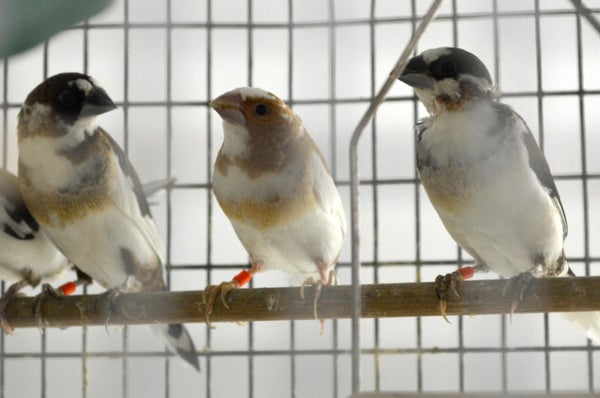
What Mets and his team wanted to know was how much of a baby bird's future musicality is influenced by that tutoring…an environmental factor…and how much is written in their genes. So they studied Bengalese finches.. which sing like this. <
On supporting science journalism
If you're enjoying this article, consider supporting our award-winning journalism by subscribing. By purchasing a subscription you are helping to ensure the future of impactful stories about the discoveries and ideas shaping our world today.
The tempo of that song appears to vary, according to a finch's genetics. So they tried training baby finches, with different genetic tendencies - fast, medium or slow singing - on a synthetic finch song, made from a library of different types of song syllables. "Tonal downward sweeps,
But when baby finches with different genetic backgrounds were trained on the resulting tune <
But then Mets flipped the experiment—exposing genetically similar birds to actual live birds that sang fast, medium, or slow. And that live training appears to have been compelling enough to override the influence of the birds' genetics. So that genetically identical chicks sang tunes fast <
The study suggests that the right kind of schooling…or environmental influences… might be able to overcome 'baked in' genetic influence on certain traits. And Mets says this push-pull of nature versus nurture might hold true for humans, too.
"We're moving very rapidly into a period where genetic data is easier and easier to collect. And an understanding of these kinds of gene-environment push/pull interactions, and how they impact ultimate phenotypic outcomes, is going to be important in understanding things like cancer susceptibility." Because that too has both genetic and environmental factors.
But no word yet on whether the genetic influences of an off-tempo human father…can be conquered with enough training.
—Christopher Intagliata
[The above text is a transcript of this podcast.]
