
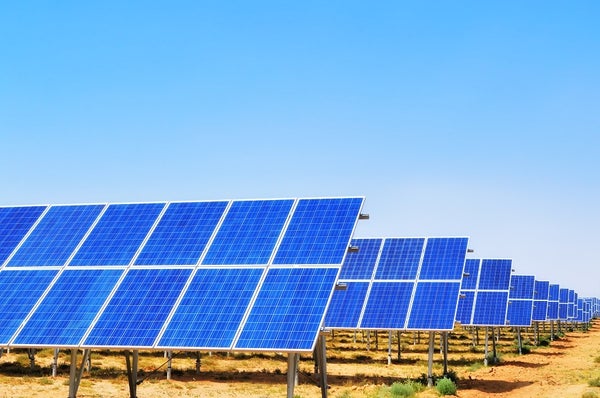

Solar companies are obviously in the business of building solar energy farms. But here's another way the solar developers are spending their money: to protect and relocate desert tortoises from their sunny desert solar farms—to the tune of at least 60 million dollars.
"It's an incredible amount of money to do something that is not necessary." Not necessary to the generation of solar energy, that is, says Rebecca Hernandez. Because why not just put your panels elsewhere?
Hernandez, an earth system scientist and ecologist at U.C. Davis, says the alternatives to developing on wild lands are many: put photovoltaic panels over rooftops or parking lots; atop salty or contaminated land, unsuitable for farming; or why not install floatovoltaics? "A floatovoltaic is a photovoltaic installation that is placed on pontoons that float on the water."
On supporting science journalism
If you're enjoying this article, consider supporting our award-winning journalism by subscribing. By purchasing a subscription you are helping to ensure the future of impactful stories about the discoveries and ideas shaping our world today.
She and her colleagues identified one and a half million football fields'worth of surface area on those types of alternative sites in California's Central Valley alone. With a combined energy generation potential of 4,300 terawatt-hours per year using the solar panels available on the market today, that's enough to power the entire United States.*
"This paper isn't to say that we think that all energy should be derived from solar energy. Obviously a diverse portfolio of energy sources helps to provide resilience to our energy systems. But really our study demonstrates that we have a lot of untapped potential out there."
The report is in the journal Environmental Science and Technology. [Madison K. Hoffacker, Michael F. Allen and Rebecca R. Hernandez, Land-Sparing Opportunities for Solar Energy Development in Agricultural Landscapes: A Case Study of the Great Central Valley, CA, United States]
Cases exist where it might be too expensive or too technically complicated to develop on these alternative sites. But if developers take a cue from Hernandez, perhaps the future of solar will be truly sustainable.
—Christopher Intagliata
[The above text is a transcript of this podcast.]
[*Editor's Note (12/23/17): The text and audio for this podcast originally quoted a figure for terawatt-hours per year using theoretical maximally efficient solar panels.That number has been changed in this revised version in keeping with currently available technology.]
