First Benefit of Knowing Your Genome

The "low hanging fruit" of genome-related health care will be knowing which drugs are likely to treat you best, says science journalist Carl Zimmer.

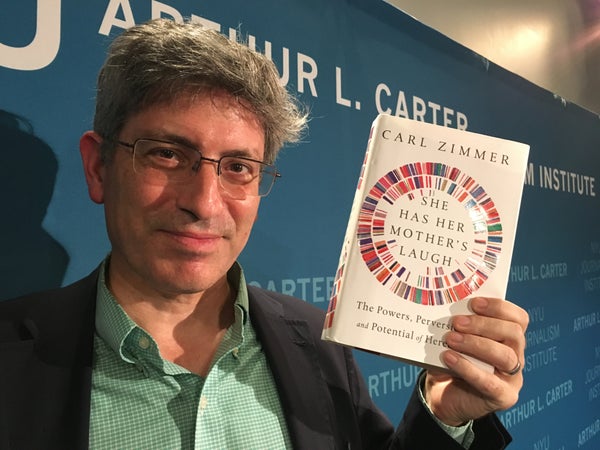
Author Carl Zimmer.

Illustration of a Bohr atom model spinning around the words Science Quickly with various science and medicine related icons around the text

Join Our Community of Science Lovers!

“I think if genome sequencing gets just super cheap then it’s…probably very soon going to make sense to just sequence all your DNA.”

Science journalist Carl Zimmer, author of the book She Has Her Mother’s Laugh: The Powers, Perversions and Potential of Heredity. Zimmer spoke last month at New York University’s Journalism Institute. Right now, commercial genome services only look at a small percentage of all your DNA. But as the cost plummets, you’ll get your entire genome.   

“Then the issue will become, well, what do you use your genome for in terms of your health. A lot of people will actually benefit from something I learned by looking at my genome, which is, that if God forbid I were to get hepatitis there are certain drugs that won’t do me any good. Because I have certain genes. Pharmacogenomics, as it’s called. I think that pharmacogenomics might be kind of the low-hanging fruit of genome sequencing. Because, doctors so often, if you get sick, they’re like, well, let’s try this. It might be hepatitis, it might be depression, all sorts of things, like, well, that didn’t work very well, let’s try this. Wouldn’t it be nice if we could just skip the stuff that doesn’t work and go to the stuff that does? So that might be kind of where medicine goes in terms of using our genomes and understanding how heredity affects your health.”


On supporting science journalism

If you're enjoying this article, consider supporting our award-winning journalism by subscribing. By purchasing a subscription you are helping to ensure the future of impactful stories about the discoveries and ideas shaping our world today.


—Steve Mirsky

[The above text is a transcript of this podcast.]

It’s Time to Stand Up for Science

If you enjoyed this article, I’d like to ask for your support. Scientific American has served as an advocate for science and industry for 180 years, and right now may be the most critical moment in that two-century history.

I’ve been a Scientific American subscriber since I was 12 years old, and it helped shape the way I look at the world. SciAm always educates and delights me, and inspires a sense of awe for our vast, beautiful universe. I hope it does that for you, too.

If you subscribe to Scientific American, you help ensure that our coverage is centered on meaningful research and discovery; that we have the resources to report on the decisions that threaten labs across the U.S.; and that we support both budding and working scientists at a time when the value of science itself too often goes unrecognized.

In return, you get essential news, captivating podcasts, brilliant infographics, can't-miss newsletters, must-watch videos, challenging games, and the science world's best writing and reporting. You can even gift someone a subscription.

There has never been a more important time for us to stand up and show why science matters. I hope you’ll support us in that mission.

Thank you,

David M. Ewalt, Editor in Chief, Scientific American

Subscribe