
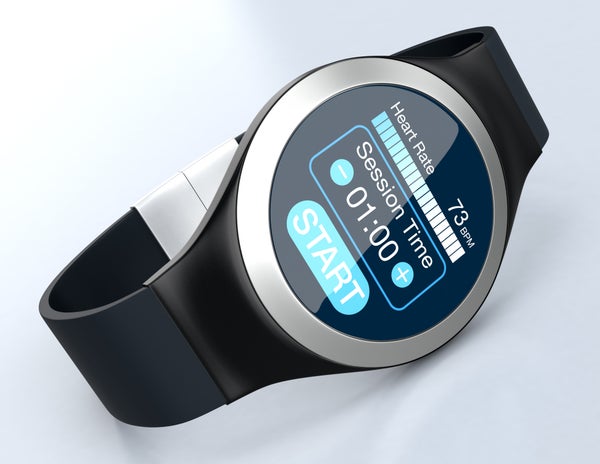

Fitness bands like the Apple Watch and the Fitbit aim to track your vitals, like heart rate. But early models weren't all thataccurate. "We thought of them a little bit like random number generators. They really didn't seem to be providing anything that bore any relationship to heart rate." Euan Ashley, a cardiologist who studies wearables at Stanford University.
He and his colleagues have now tested seven newer fitness bands—from brands like Apple, Fitbit and others—and he says those heart rate stats have gotten way better. "Yeah we were pleasantly surprised actually by how good the accuracy of the heart rate monitoring was."
For most of the devices, the error rate was less than five percent—good enough for your doctor. But where all the devices failed to measure up was estimating calories burned. Even the most accurate devices were off by 27 percent, compared to lab measurements of energy expenditure. One device was off by more than 90 percent.
On supporting science journalism
If you're enjoying this article, consider supporting our award-winning journalism by subscribing. By purchasing a subscription you are helping to ensure the future of impactful stories about the discoveries and ideas shaping our world today.
"If you think about going to the gym and working out for an hour and maybe that's around 400 calories, in reality that could be anything from 200 to 800. And that's a big difference if you're thinking about somebody who's incorporating those estimates into their lifestyle and thinking about what to eat that evening based on the workout they did that afternoon." The results are in the Journal of Personalized Medicine. [Anna Shcherbina et al., Accuracy in wrist-worn, sensor-based measurements of heart rate and energy expenditure in a diverse cohort]
The reason for the discrepancy, Ashley says, could be that we all burn energy at different rates—and that's hard to reckon from simple input stats like weight and height. "Some people are incredibly efficient and look incredibly elegant when they run. And others really clearly look like they're burning a lot more calories to cover the same amount of ground." So if you own a wearable, it's probably safe to trust the heart data. What it can't tell you is whether your time on the treadmill really justifies that chocolate shake.
—Christopher Intagliata
[The above text is a transcript of this podcast.]
