
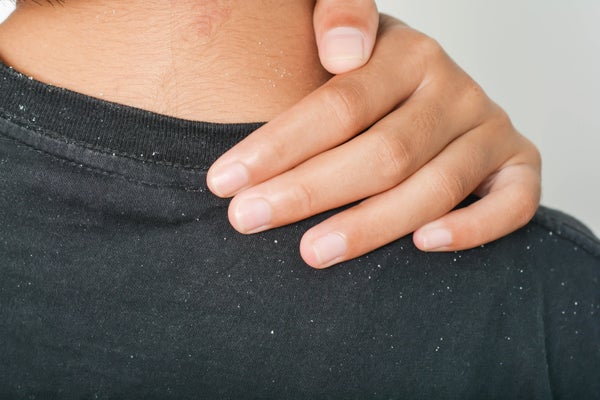

There’s a lot of advertising mythology about what causes dandruff. Like this:
[CLIP: “Here's why clean scalp is important. Your hair roots must breathe—]or there’s trouble; deep trouble; dandruff.”]
“Dandruff itself is actually a very, very complicated condition.”
On supporting science journalism
If you're enjoying this article, consider supporting our award-winning journalism by subscribing. By purchasing a subscription you are helping to ensure the future of impactful stories about the discoveries and ideas shaping our world today.
Barry Murphy, a microbiologist and molecular biologist at Unilever in the U.K., says dandruff is a perfect storm of flakiness—involving your fungal microbiome, the health and oiliness of the skin on your scalp, even weather!
His team set out to investigate the microbial component. They sequenced DNA from the heads of people with healthy hair and others with dry, dandruffy scalps—none of whom had used antidandruff shampoo within the last six months.
As previous studies have found, they spotted 10 times as much of a type of fungus called Malassezia on dandruff scalps versus the healthy cohort. But they also found that populations of a bacterium called Staphylococcus capitis spiked on flaky scalps.
“Really, really interestingly, we found there was approximately 100 times more of this bacteria on a dry or a dandruff scalp than there was on a healthy scalp.”
But it’s still a mystery why it’s there—or what it’s doing. The results are in the journal PLOS ONE. [Sally G. Grimshaw et al., The diversity and abundance of fungi and bacteria on the healthy and dandruff affected human scalp]
Murphy’s employer Unilever makes its own antidandruff products. So this could be useful information someday. But rather than just zapping scalp fungi with antifungal compounds like most of today’s antidandruff shampoos do, Murphy says the goal might be to make a more gentle product.
“It should be about trying to restore an equilibrium. It should be about microbiome balance. It should be about the very fact that we’ve lived in harmony with these microbes for millions and millions of years.”
Either way, it seems the old lore that a dandruffy scalp just needs a thorough “cleaning” might be a little flaky.
—Christopher Intagliata
[The above text is a transcript of this podcast.]
