

Charles Darwin is most famous for his finches, from whose beaks he gleaned the idea that a single species might radiate into many.
But he studied other attributes of birds, too—like the rhythmic sounds some species made during courtship by fluttering, shaking or rattling their feathers together.
[CLIP]
On supporting science journalism
If you're enjoying this article, consider supporting our award-winning journalism by subscribing. By purchasing a subscription you are helping to ensure the future of impactful stories about the discoveries and ideas shaping our world today.
“Since Darwin, there’s been this fact that birds produce sounds with wings and tails or flight feathers. So there’s species of manakins that do this sound; there’s hummingbirds that do this sound.”
Valentina Gómez-Bahamón is an evolutionary biologist and ornithologist at the Field Museum in Chicago.
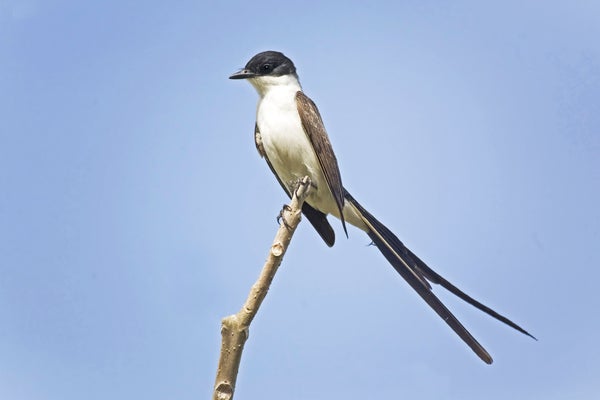
She and her team have now observed that nonvocal-sound-production phenomenon in another type of bird: the fork-tailed flycatcher. The researchers studied two groups of the birds in South America—and recorded the birds making these fluttering sounds with their wings during morning courtship rituals ...
[CLIP]
... and in combat between males.
[CLIP]
One of the two flycatcher subspecies is migratory. The other stays put. And by carefully measuring the birds’ feathers, the research team found that the migratory birds had longer, thinner feathers—presumably for some aerodynamic advantage. But that altered feather shape also meant the birds’ fluttering produced a different frequency.
Compare the migratory birds’ flutter ...
[CLIP]
... to the stationary birds’.
[CLIP]
“So basically what we think is that because of loss of migration, pressures for flight may influence the shape of the individual feathers to the point where the sound quality changes.”
The details are in the journal Integrative & Comparative Biology. [Valentina Gómez-Bahamón et al., Sonations in Migratory and Non-migratory Fork-Tailed Flycatchers (Tyrannus savana)]
Gómez-Bahamón says they’re still not certain what role the sounds play in day-to-day flycatcher life—if the birds do indeed even pay attention to them. But she suspects the sounds may have some cultural importance to the birds.
In which case, she says, the communication differences between the migratory and nonmigratory birds could further divide the two types of birds—or in other words, give rise to the origin of species.
—Christopher Intagliata
[The above text is a transcript of this podcast.]
