
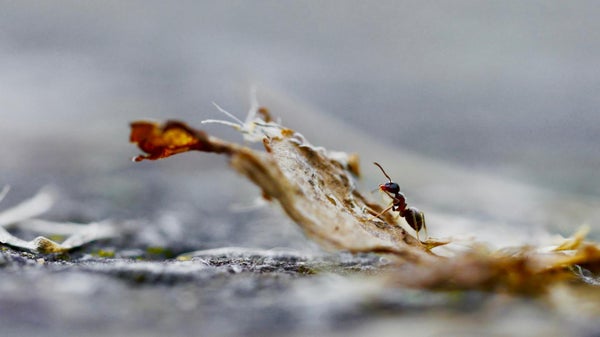

GPS has completely transformed how we get around. But other animals have long had their navigation systems built right in—like ants and bees.
“We know their eyes are quite sensitive to polarized light, and the sky has a particular pattern of polarized light, relative to the position of the sun.” Barbara Webb, a bioroboticist at the University of Edinburgh.
You can see polarized light firsthand if you take a pair of polarized sunglasses and rotate them against the sky—the light passing through the lenses changes. Webb says the insects have polarization built into facets of their compound eyes.
On supporting science journalism
If you're enjoying this article, consider supporting our award-winning journalism by subscribing. By purchasing a subscription you are helping to ensure the future of impactful stories about the discoveries and ideas shaping our world today.
“You can think of it as the equivalent of having a little polarization directional filter over them or lots of sunglasses pointed in different directions.”
But Webb was curious whether there’s really enough information in the sky to give insects an accurate sense of direction. So her team built a sensor modeled after a desert ant eye and put it under artificial light meant to simulate the sky. They then fed that sensor input into a computational model meant to mimic the brains of desert ants, crickets and other insects with a celestial compass.
And they found that with the insects’ innate sensing and processing equipment, they can likely sense compass direction down to just a couple degrees of error. The results are in the journal PLOS Computational Biology. [Evripidis Gkanias et al., From skylight input to behavioural output: A computational model of the insect polarised light compass]
A system based on that of insects could someday be a cheap, low-energy alternative to GPS. “Insects have very tiny brains. A brain the size of a pinhead that’s using hardly any energy. And yet they’re still able to navigate better than we can with GPS, which is a huge infrastructure.”
Webb is now working on building a robot that can, like the desert ant, use light to get its bearings. Although after sundown, it may have to ask for directions.
—Christopher Intagliata
[The above text is a transcript of this podcast.]
